|
|
I
have not had much time to get many items in the forsale area below.
Please keep checking back as I will start adding more items soon.
Items
For Sale
|
|
Socket
& Electrical Manufacturer's Items And Their History
|
GECO
Sockets
This section will allow you to date and learn
how to tell one GECO socket from the other.
Hubbell
This is where this site started from. Since this page
was done, there has been much more Hubbell history and information
found which will make for a complete redesign of this page and section
in the soon future.
Hubbell Patents
This section has some early patent research on Hubbell.
It is mostly complete with only a few missing patents which will be
added in when this section is re done into the new format
Wheeler Reflector
Co.
A history of The Wheeler Reflector Company and tips
on how to tell if mirror has been replaced on a shade
Other Manufacturers
This section is a lot of incomplete
work and will be updated shortly. For now it serves to give you some
extended information on some companies, but will be a much better
tool when it is complete
NEC
This section is everything you ever wanted to know about the National
Electrical Code (NEC) but had no one to ask. Downloads of old NEC's,
meetings and much extended information is provided.
Cord Balls & Adjusters
My cord pendant adjuster project, as well as
a good history about them.
|
|
Tutorial
And Early Lighting History
|
|
The Lighting Time Table
To
read the entire tutorial, you can just click on the first link and
then continue to the next section at the bottom of each page. Or,
you can select links below of interest to you.
PRE 1900 SECTION
Overcoming Obstacles
About Early Electric Lighting, Generators, Arc Lamps,
The First Edison Socket, Menlo Park, etc.
The
First Fixtures
About The Start Of The First Incandescent Lighting
Fixtures
Light
Reflection
About Early Light Bulbs And Candle Power vs. WATTS
Edison-Bergmann
About Sigmund Bergmann And The Start Of Bergmann
And Company Lighting Fixtures
Lighting
Break Down
A Quick Break Down Of Different Lighting Time Periods
Styles
1881 to 1884
Bergmann Fixtures And Styles
Other
Pre-1888 Styles
About Early Companies That Sold Lighting Systems
And The Fixtures That They Sold With Their Lighting Systems
The
U.S. Elect. Co.
The United States Electric Company History And Early
Items
The
Brush Elect. Co.
The Brush Electric Company History And Early Items
Thomson-Houston
The Thomson-Houston Electric Company History And
Early Items
Westinghouse
About The Westinghouse Manufacturing Company History
And Early Mergers
Mid
1880's Styles
About The Start Of Electrical Supply Houses and
how new lighting styles came about
Pre
1900 Sockets
About Early Light Sockets And How To Tell The Difference
1887
New Items
1888
New Items
1890
New Items
1891
New Items
1892
New Items
1893
New Items
1894-1896
Items
1897
New Items
1898
New Items
1899
New Items
Above are catalog items sold in different years. There is no space
to duplicate items, so only new and unique items from each year
are shown. You would need to view the catalogs for yourself to be
complete as I am only highlighting items. You can view catalogs
here.
EXTRA INFO
Victor
Shade Holder
About The Victor Shade Holder, Atwood And The Standard
Holder
I.P.
Frink 1899 Items
About
Frink & Wheeler
New
Wheeler Inverted
Three Links About Mirror Reflector Manufacturers
And Their Items And History.
Wheeler Reflector
Co.
NEW - A history of The
Wheeler Reflector Company and tips on how to tell if mirror has
been replaced on a shade
Early Desk Lamps
Some Help In Telling Them Apart
Vitrite And Luminoid
About The Vitrite Holders And Early Vitrite History
Brush-Swan Holder
About Brush-Swan Shade Holders
Cord
Balls
My cord pendant adjuster project, as well as a good
history about them.
POST 1900 SECTION
About
1900 Styles
This section covers a basic into into the 1900 section
covering information about the 1899 transition, electrical code
changes, lighting influence, sharing and licensing of patents and
then into the new section of electrical specialty manufacturers,
Electrical Specialty Manufacturers
Harvey
Hubbell
This section covers some early history periods of
pre Hubbell-Grier, Hubbell-Grier, Harvey Hubbell, Hubbell Company.
It also covers a number of items that helped change lighting styles,
Benjamin
This section covers some early history periods for
the Benjamin Electric MFG. Co, as well as a small section on Dale
and The Federal Electric Company
Dale
Federal
Electric
This post 1900 section continues to be under current
construction
Please Check Back.
|
|
|
PERSONAL
PROJECT
PENDANT
CORD BALLS & OTHER TYPES OF ADJUSTERS
|
| |
|
SPECIAL
PAGE VIEW - PERSONAL PROJECT - PENDANT
CORD BALLS
|
For the last
couple of months, I have been working on methods of making copies
of pendant cord balls of different types.
As you know, I am more of a purest when it comes to lighting items.
I like to keep items in all original condition, and have almost
a hate for reproductions of any kind.
The real problem is, that these balls are hard to come by.
Also the demand for them is growing and it is becoming harder and
harder to find them in the wild, without the need of paying too
much for them.
The last one that I lost in auction went for almost $200.00 (and
I would had bid more, if I would have expected it to go that high.
This experience alone, convinced me that these little wooden balls
needed more research.
It has also made me re think (to a small degree) my purest convictions,
when it comes to a only a little wood ball that is so essential
to cord pendants and so hard to come by.
I decided to work towards a solution that would be acceptable not
only to those that need them, but also a purest like myself when
it comes to appearance, materials and manufacturing methods.
I believe that if they need to be done, they need to be done right!
This is the
reason that I have put so much time into this project (and will
put much more time and research into this through this year).
About My Prototypes
While it may had been easy to make a nice shinny finish and some
nice wood tones, that is not my goal at this time. Right now, the
look and feel that I am trying to accomplish is a product that will
complement an untouched piece from the 1880's through 1900.
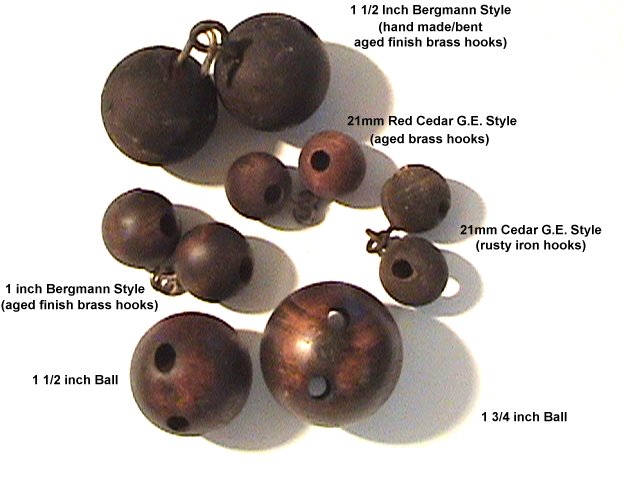
Right now I am perfecting three different basic types of cord balls
(prototypes shown below)
1. Bergmann
Style Hook Balls (Circa 1885 to before 1889)
2. EGE
& General Electric Co. Linked Balls (Circa 1891 to
1909)
3. Common
Cord Balls
(Circa 1889 to about 1930)
(note that I will be doing some other styles later)
- My prototypes
shown on this page are all hand made - ONE AT A TIME
- No two balls
are identical in finish or patina
- Careful attention
to detail is taken when making each ball
- Multiple
re checks and touchups are done through a long process (days)
of waiting for each step to complete
So far I have
put a lot of work into this, as you should be able to see from the
examples shown.
The results on this page have come through much trial and error.
I have also visited with some friends well experienced in furniture
restoration. They have shared some of their techniques, and I have
developed some of my own as well. I am working on other types of
adjusters and different styles of balls not yet shown here, as they
are still in testing phases.
CURRENT PROTOTYPES
|
BERGMANN
STYLE HOOK BALLS - Circa 1885 to
before 1889
|
THE EDISON-BERGMANN 1880's ADJUSTABLE CORD PENDANTS AND CORD
PENDANT BALLS
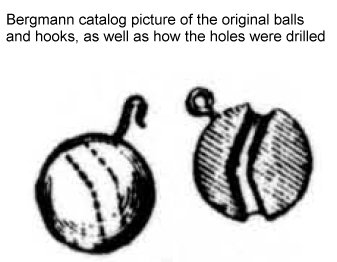
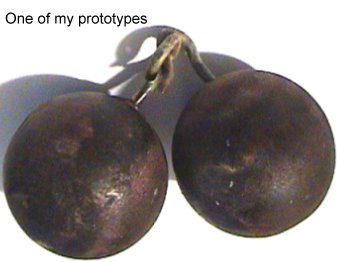
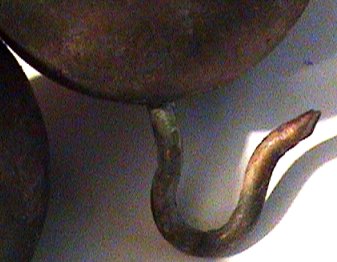
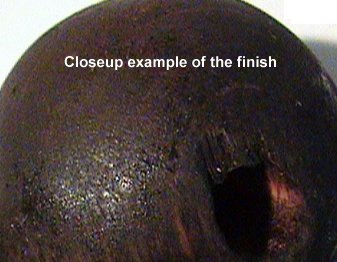
The first type is taken directly from the Bergmann No. 5 catalog.
I do not know how long this exact style was around, as Bergmann
catalogs are hard to come by. I have copies of the 1883 (No. 1)
catalog which does not yet show these. The next Bergmann catalog
that I have is No. 5 (about 1884/1885) which does show and sell
these balls. The next catalog that I have access to is No. 11 (1889)
which no longer shows this style ball. (Please contact me if you
have any Bergmann catalogs other then talked about on this page).
In 1889 Bergmann merged into the Edison General Electric Company.
In the 1891 EGE catalog, this ball style changed to smaller
balls permanently linked together, possibly with straight
through (non-curved holes).
This unique ball which I refer to as the "Bergmann Style",
was a great working design.
Note that the holes for the cord are curved, which required two
holes to be drilled at an angle that met in the center of each ball.
This design causes the cord to fit tightly, which means that even
heavy pendants work well. Other designs may sometimes allow the
cord to slip easily with heavy shades.
This design also allows someone to preset a distance of cord for
a quick adjustment.
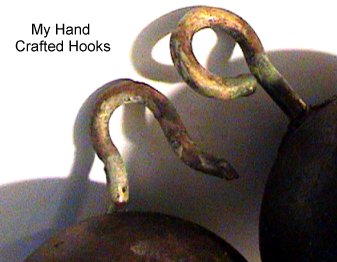
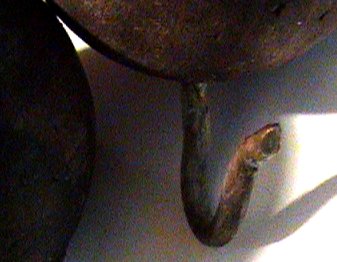
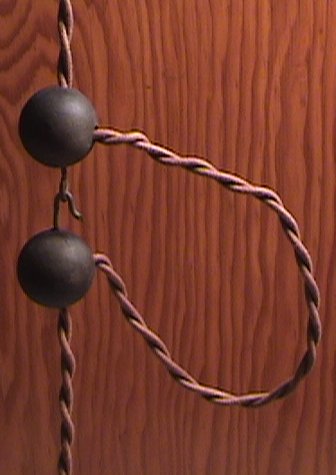
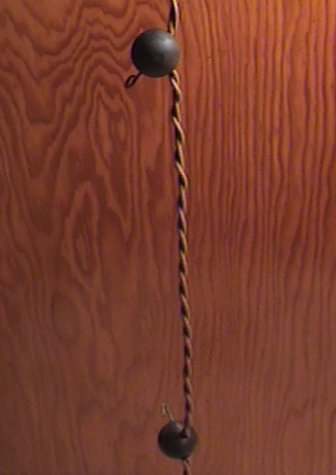
Hook the balls together to raise the light, or easily un hook the
balls to bring the light down.
Note: Three sets of the style shown below were made as prototypes.
All three sets have been sold.
The first set was sold on a pendant (with full disclosure) and the
other two sets on ebay noted as my prototype examples.
 |
 |
 |
 |
 |
 |
|
IN - USE EXAMPLE - HOOKED
|
IN - USE EXAMPLE - UNHOOKED
|
 |
 |
| |
|
| To
see more examples of Bergmann prototypes like those above, click
on the link below to see additional photos:
http://antiquesockets.com/ballgallery.html |
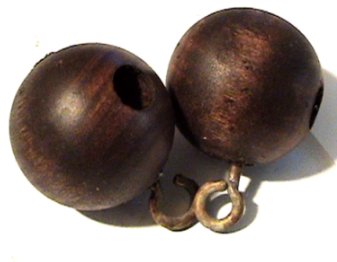
SMALLER
1 INCH PROTOTYPES
I have also done the Bergmann style above in a smaller one inch
ball as shown to your right.
The hooks are more like the G.E style ball, but with the eye
open on one side so that it can be hooked.
If these smaller balls are desired by others in the future,
I will take the time to craft better hooks for them.
|
 |
| LINKED
BALLS -
E.G.E. & The General Electric Company - Circa
1891 to 1909 |
There is some information to be gleaned from the catalogs, but
the fact is that even with many different examples of these
balls, there is still some uncertainty as to it's true design.
|
More
then likely, these G.E. style balls went through some minor
changes through the years.
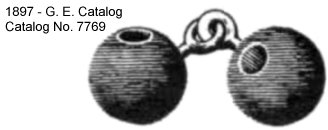
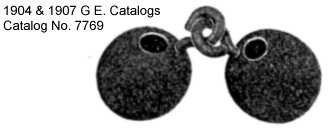
The important things to pay close attention to in the catalog
pictures (shown on your right) are the hooks, and trying to
notice if the holes in the balls are straight or curved.
|
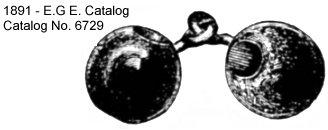 |
The
1891 and 1897 catalog pictures seem to show a straight through
hole drilled to somewhat of an angle (on the left ball), to
how the ball is resting in the picture. While the hook could
be open on the 1891 (right ball), the 1897 catalog picture is
clearly closed. There is no doubt in my mind that these are
straight through holes in both the 1891 and 1897 examples.
|
 |
In
the 1904 and 1905 catalog pictures, the hooks have changed to
a new style. It is clear though from the picture, that there
is no room for the hook to detach like on the older Bergmann
styles.
The last G.E. catalog to sell this style ball was their 1909
company catalog, but no longer offered an illustration for it.
|
 |
The
first catalog was the EGE 1891 catalog, but by the time that
G.E. was formed (1892) it was no longer offered (or at least
it was not in the 1894 catalog). I also have a 1896 Canadian
G-E catalog which still does not offer it.
The next G.E. catalog that I have that picks it up again is
the 1897 catalog. |
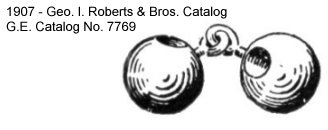 |
I
do not know where the 1907 Roberts catalog got their image from,
seeing it was not a copy of any of the G.E. images. Also the
last G.E. catalog to sell these balls was the 1909. At least
the part number is correct and is what we would expect to see
during this time.
HOWEVER, the 1918 catalog is a total mystery!
Maybe Western Electric bought a LARGE quantity of these before
1909 (or earlier), OR they or someone else was making them.
|
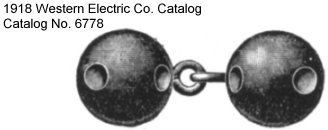 |
Notice also the holes could be the same as the older Bergmann
style, but in my tests comparing my prototypes at different
angles likely not. These balls pictured may be larger and have
two straight through holes on each ball. Also note that the
catalog number is closer to that of the 1891 G.E. catalog number.
|
|
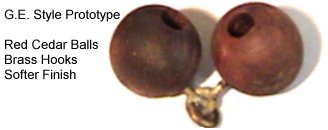
PROTOTYPES
OF MY GENERAL ELECTRIC STYLE LINKED BALLS
|
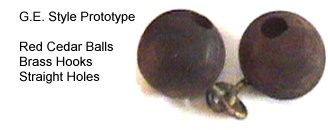
All
of my holes are drilled 9/32' as they were for most standard
twisted cord (example no. 16 lamp cord).
When portable and showroom window cord started to become more
popular, most balls started offering new optional larger size
holes, which were 13/32". |
 |
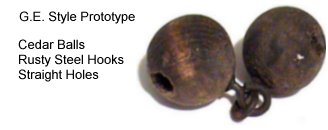
This
style ball however never offered the new size holes.
This was likely due to the smaller size of the balls.
When you start drilling larger holes, the small balls are more
likely to chip, crack, or break.
For more information on holes and different lamp cords, see
my section on this below. |
 |
 |
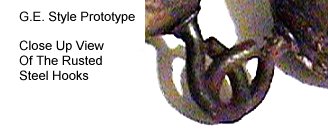 |
I
added some close up photos of the balls above, to my ball gallery
at the link below:
http://antiquesockets.com/ballgallery.html#steel |
|
|
|
COMMON
TYPE CORD BALLS
- (Circa 1889 to about 1930)
|
|
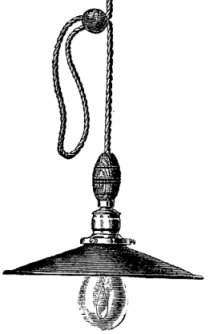
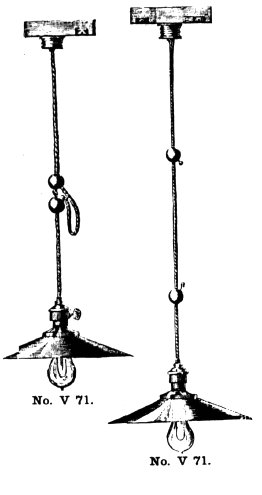
The most common of all cord adjusters (but still rare to find
today) was the standard two hole "Cord Ball".
The first documented use that I find for one of these balls
is in the 1889 Fred. M. Kimball & Co. catalog, which is
shown in the picture of the pendant to your right.
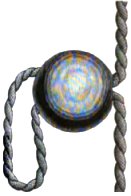 While
the first documented "flexible pendants" were made
by Edison and the first hook balls by Bergmann in the early
1880's, by 1890 most manufacturers and distributors were selling
their own or some type of cord adjuster. While
the first documented "flexible pendants" were made
by Edison and the first hook balls by Bergmann in the early
1880's, by 1890 most manufacturers and distributors were selling
their own or some type of cord adjuster.
The most popular of pendant adjusters was the two hole wood
adjusting ball shown here. The cord ball went by many different
names, but they are all basically the same thing. A round
wooden ball with two holes that was used to adjust the height
of the cord pendant.
The adjusting ball was offered in catalogs from 1889 until
about 1930. (sampled from my personal catalog collection most
but not all of which is shown here).
In these catalogs, it was offered with finishes such as Black
Enamel, Maple, White and Cherry.
|
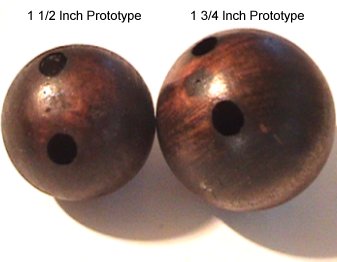
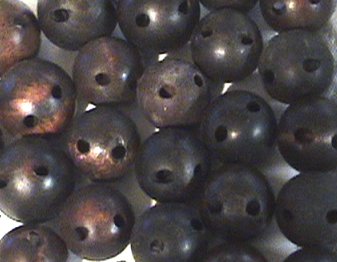
PROTOTYPES
OF MY WOODEN CORD BALLS
|
 |
 |
|
A
Picture Showing Two Different Sizes
|
A
Picture Showing Different Finishes And Conditions
|
| |
|
I
added some close up photos of the balls above, to my ball
gallery at the link below:
http://antiquesockets.com/ballgallery.html#cordballs |
|
|
|
CORD
SIZES AND ELECTRICAL CODES
|
Prior to the 1899 National Electrical Code, "Fixture
Wire" and "Flexible Cord" only required
1/64 inch of rubber insulation covering the copper
wire. In 1899 most applications of flexible cord
and fixture wire now required 1/32 inch of rubber
insulation. This made the wire much thicker and
older cord balls and adjusters no longer worked
on some pendants.
Since the older insulated wire was still being sold,
manufacturers needed to adapt and make their adjusters
work well with either size wire. Some adjusters
simply used two sizes. Another type of wire became
much more popular in later years also, which was
made for store display windows and portable lamps
(work lights). This wire was twice the size of regular
twisted lamp cord. Catalogs started offering two
sizes of holes about this time and described the
sizes as "Standard" and "Portable".
Sometimes you will see "Show Window" size
in the place of portable, since it was basically
the same wire and described in electrical catalogs
this way. The holes drilled in portable size adjusters
was 13/32 inches.
The standard hole size in all of my prototype balls
is the same that was used after the electrical code
changes which is 9/32 inches. I can make special
13/32 inch for industrial cord if needed.
|
|
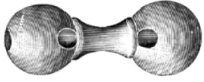
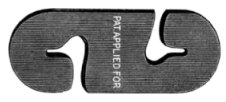
There
were also MANY other types of adjusters through the years,
I have only listed the most popular adjusters below as an
example for you.
|
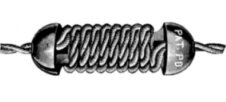
The
Dumbbell Adjuster
|
The
Q&S Adjuster
|
The
Universal Adjuster
|
 |
 |
 |
|
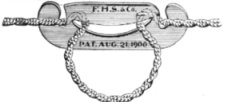
The
Stewart Adjuster
|
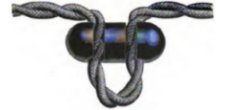
The
BAR Adjuster (hard rubber)
|
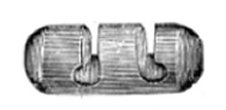
The
BAR Adjuster (wood)
|
 |
 |
 |
 The
Dumbbell- Made of wood with a clear finish. I have found
this in catalogs from 1897 to 1921. The only patent I could
find was applied for on April 2nd 1904 (patent no. 783,743)
which must be an improvement to the first design, or a late
patent application seeing it is in earlier catalogs. The
Dumbbell- Made of wood with a clear finish. I have found
this in catalogs from 1897 to 1921. The only patent I could
find was applied for on April 2nd 1904 (patent no. 783,743)
which must be an improvement to the first design, or a late
patent application seeing it is in earlier catalogs.
The Q&S - The Q&S is also known as "The
Flat Adjuster". It was made from Red Fiber.
I have found this adjuster in catalogs from 1891 to 1921.
The patent number for this adjuster is 479,509,
which was applied for on November 11th 1891 and approved July
26th 1892.
The Universal - The Universal adjuster (patent no.
741,154)
was made from wood and offered finishes such as Black Enamel,
Cherry, Green, Red and unfinished plain wood. It came in three
different sizes for different types of cord. For standard
cord (old pre-1899 electrical code wire) the standard size
of 3 3/4 inches was used. For new code standard wire, the
5 1/8 size was sold. I could not find the third size mentioned
in catalogs other then described as the "Showroom Window"
cord size. Since the "Showroom Cord" is two times
the size of standard lamp cord, I would guess that the third
size was much more larger then the 5 1/8 inch adjuster. I
have found these in catalogs from 1904 to 1930, but would
had been around a bit earlier as the patent was applied for
July 2nd 1902.
The Stewart - The Stewart Adjuster got its name from the
Inventor Frank. H. Stewart of the Frank H. Stewart Electric
Company. It was offered in both red and black fiber. I have
found this adjuster in catalogs from 1900 to 1908. I should
also note that it is not found in the 1909 Frank H. Stewart
Company catalog. It was likely discontinued about this time.
The patent number for this adjuster is 656,431
which was applied for May 9th 1900 and approved on August
21st 1900.
The BAR - The BAR adjuster is also know in catalogs as
the "Peanut", as well as the "Improved Adjuster".
It was offered in both wood and black hard rubber. The wooden
versions were sold with finishes such as Black Enamel and
Cherry. I have found this adjuster in catalogs from 1891 to
1923.
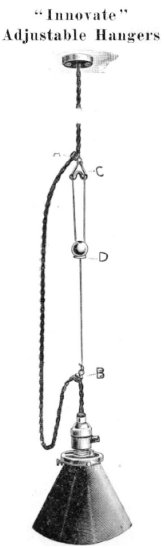
The Innovate - The "Innovate" (patent no.
794,671)
shown on your right has been added to this section, since
it shows up in so many catalogs through the years starting
about 1905 until the mid 20's.
|
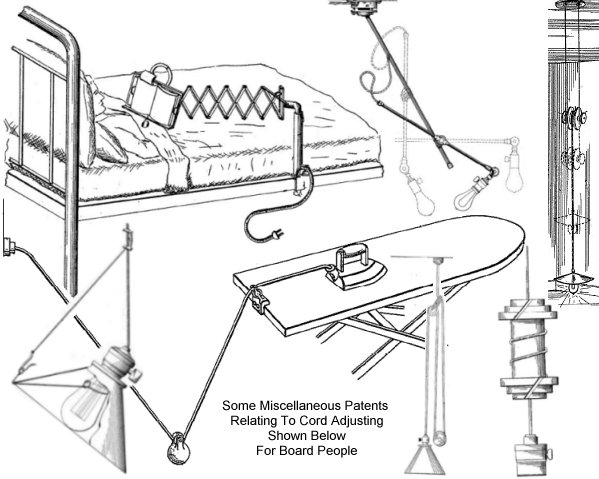
MISCELLANEOUS
ADJUSTING PATENTS
|
|
|
|
|
|
|
|
|
|
|
|
|
|
|
|
|
|
|
|
|
|
|
|
|
|
|
|
|
|
|
|
|
|
|
|
|
|
|
|
|
|
|
|
|
|
|
|
|
|
|
|
|
|
|
|
|
|
|
|
|
|
|
|
|
|
|
|
More...
(keep checking back)
|
|
|
|
| |
|
|
|
|
|
|
|
|
|
|
|
|
|
|
|
|
|
|
|
|
|
|
|
|
|
|
|
|
|
|
|
|
|
|
|
|
� COPYRIGHT ALL RIGHTS RESERVED
Contact
Us - Send Private Email To the Admin
|