|
Learning
Tools And Research Material
|
User Forums
Post pictures of your items and ask questions or just
learn from reading the posts from others
Ad
Database
View or upload ads from antique magazines
Bulb
& Socket Bases
View images of the most well known bulb and socket bases
Patent Utilities
Patent
Linker
Lets You Pull Up Any Patent PDF File Or Link One Directly
To Your Web Page
Group Patent Dbase
Lets
You Download The First Page Patent Picture Of Every Patent On A Single
Day To View On Quickly Your Local Computer
MultiView Search
Lets
You Search For Patents Using Advanced Methods And Provides Hyper Links
To The Patent Office And Google Patents |
|
|
I
have not had much time to get many items in the forsale area below.
Please keep checking back as I will start adding more items soon.
Items
For Sale
Cord
Balls & Adjusters
NEW - My cord
pendant adjuster project, as well as a good history about them.
|
|
Socket
& Electrical Manufacturer's Items And Their History
|
GECO
Sockets
NEW
- This section will allow you to date
and learn how to tell one GECO socket from the other.
Hubbell
This is where this site started from. Since this page
was done, there has been much more Hubbell history and information
found which will make for a complete redesign of this page and section
in the soon future.
Hubbell Patents
This section has some early patent research on Hubbell.
It is mostly complete with only a few missing patents which will be
added in when this section is re done into the new format
Wheeler Reflector
Co.
NEW - A history of The
Wheeler Reflector Company and tips on how to tell if mirror has been
replaced on a shade
Other Manufacturers
This section is a lot of incomplete
work and will be updated shortly. For now it serves to give you some
extended information on some companies, but will be a much better
tool when it is complete
NEC
This section is everything you ever wanted to know about the National
Electrical Code (NEC) but had no one to ask. Downloads of old NEC's,
meetings and much extended information is provided.
|
|
Tutorial
And Early Lighting History
|
|
The Lighting Time Table
To
read the entire tutorial, you can just click on the first link and
then continue to the next section at the bottom of each page. Or,
you can select links below of interest to you.
PRE 1900 SECTION
Overcoming Obstacles
About Early Electric Lighting, Generators, Arc Lamps,
The First Edison Socket, Menlo Park, etc.
The
First Fixtures
About The Start Of The First Incandescent Lighting
Fixtures
Light
Reflection
About Early Light Bulbs And Candle Power vs. WATTS
Edison-Bergmann
About Sigmund Bergmann And The Start Of Bergmann
And Company Lighting Fixtures
Lighting
Break Down
A Quick Break Down Of Different Lighting Time Periods
Styles
1881 to 1884
Bergmann Fixtures And Styles
Other
Pre-1888 Styles
About Early Companies That Sold Lighting Systems
And The Fixtures That They Sold With Their Lighting Systems
The
U.S. Elect. Co.
The United States Electric Company History And Early
Items
The
Brush Elect. Co.
The Brush Electric Company History And Early Items
Thomson-Houston
The Thomson-Houston Electric Company History And
Early Items
Westinghouse
About The Westinghouse Manufacturing Company History
And Early Mergers
Mid
1880's Styles
About The Start Of Electrical Supply Houses and
how new lighting styles came about
Pre
1900 Sockets
About Early Light Sockets And How To Tell The Difference
1887
New Items
1888
New Items
1890
New Items
1891
New Items
1892
New Items
1893
New Items
1894-1896
Items
1897
New Items
1898
New Items
1899
New Items
Above are catalog items sold in different years. There is no space
to duplicate items, so only new and unique items from each year
are shown. You would need to view the catalogs for yourself to be
complete as I am only highlighting items. You can view catalogs
here.
EXTRA INFO
Victor
Shade Holder
About The Victor Shade Holder, Atwood And The Standard
Holder
I.P.
Frink 1899 Items
About
Frink & Wheeler
New
Wheeler Inverted
Three Links About Mirror Reflector Manufacturers
And Their Items And History.
Wheeler Reflector
Co.
NEW - A history of The
Wheeler Reflector Company and tips on how to tell if mirror has
been replaced on a shade
Early Desk Lamps
Some Help In Telling Them Apart
Vitrite And Luminoid
About The Vitrite Holders And Early Vitrite History
Brush-Swan Holder
About Brush-Swan Shade Holders
Cord
Balls
My cord pendant adjuster project, as well as a good
history about them.
POST 1900 SECTION
About
1900 Styles
This section covers a basic into into the 1900 section
covering information about the 1899 transition, electrical code
changes, lighting influence, sharing and licensing of patents and
then into the new section of electrical specialty manufacturers,
Electrical Specialty Manufacturers
Harvey
Hubbell
This section covers some early history periods of
pre Hubbell-Grier, Hubbell-Grier, Harvey Hubbell, Hubbell Company.
It also covers a number of items that helped change lighting styles,
Benjamin
This section covers some early history periods for
the Benjamin Electric MFG. Co, as well as a small section on Dale
and The Federal Electric Company
Dale
Federal
Electric
This post 1900 section continues to be under current
construction
Please Check Back.
|
|
UNDER
CONSTRUCTION
|
SOCKET & ELECTRICAL DATING TUTORIAL
|
There are many different methods
that can be used to help you date your items or sockets.
This tutorial will help you identify which methods will be best
for your item. If your item is post 1900, you will notice that
some of these methods will not apply to you. This is because
some dating methods may provide a broad date range for some
items, such as the date that porcelain started being used for
socket switches. On the other hand this method would be more
helpful if you were dating a much older socket during the transition
of fiber to porcelain.
By browsing these different areas you should be able to identify
and narrow down your item close to it's manufacture date. In
some cases even within several months.
|
|
Before reading this section
(if you already know a bit about his topic) you may want to test your knowledge
first be taking a short quiz. This way after you are done reviewing this
section you can take the quiz again to see how much information that you
have retained.
The quiz links below will let you test your current knowledge on this topic.
Be sure to write down your total score.
This way you can come back later to see how much better you do after reviewing
this section.
|
DATING BY SWITCH MATERIAL USED
Wood
/ Fiber / Porcelain
|
| Switch
Material |
Wood
1879 - 1882
|
Vulcanized
Fiber 1882 - 1890
|
Porcelain
1890 - Present
|
| By
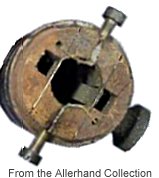
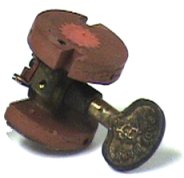
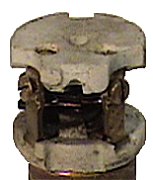
the year 1883 most manufactures were using vulcanized fiber
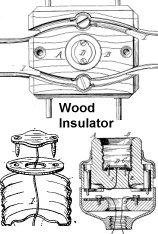
for switches. Wood continued to be an insulator for fuse cut-outs
and other electrical products for years after. Vulcanized fiber
came in several colors such as brick red, brown, gray, and black.
|
|
|
|
|
Many
people mistake the darker fiber materials for hard wood because
of the crude finish and some cracking that sometimes comes
along with age. By 1890 most manufactures switched from fiber
to porcelain.
|
|
|
|
|
DATING BY CODE STANDARDS
The National Electrical code of 1899
|
|
Lining
|
Shell
|
Marking
|
|
The
inside of the shells must be lined with insulating material,
which shall absolutely prevent the shell from becoming a part
of the circuit even though the wires inside the socket should
start from their position under binding screws. The material
used for lining must be at least one- thirty-second of an
inch in thickness, and must be tough and tenacious. It must
not be injuriously affected by the heat from the largest lamp
permitted in the socket, and must leave the water in which
it is boiled practically neutral. It must be so firmly secured
to the shell that it will not fall out with ordinary handling
of the socket. It is preferable to have the lining in one
piece.
|
Metal
used for shells must be moderately hard, but not hard enough
to be brittle or so soft as to be easily dented or knocked
out of place. Brass shells must be at least 0.013 inch in
thickness, and shells of any other material must be thick
enough to give the same stiffness and strength of brass.
|
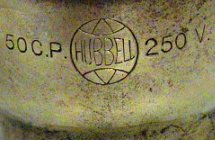
The
standard socket must be plainly marked fifty candle-power,
250 volts, and with either the manufacturer�s name or registered
trademark. Special large sockets must be marked with the current
and
voltage for which they are designed.
|
By the year 1900 virtually all socket manufactures had adopted
these new NEC standards.
From the three selections above, Lining and Marking will be
the most common methods for dating.
Marking
As a general rule all sockets after 1900 are marked with a
Company name or trademark logo of some kind.
It is also marked with the voltage as well as the CP or WATT.
If the socket shell has no markings it is likely a pre-1900
socket.
Lining
The current socket designs would not allow for the room that
would be needed to secure a full insulating liner of the thickness
required. This caused the need for almost all manufactures
to change the basic design of their socket shells. (see shell
design section)
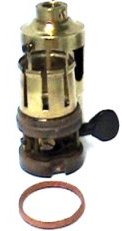
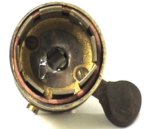
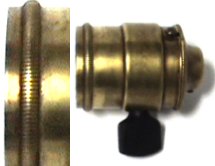
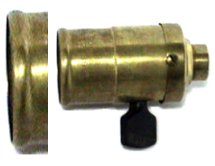
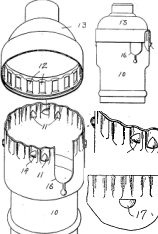
The
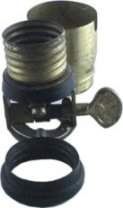
first socket and liner shown above is an
example of the first type of liner.
This was a threaded ring that screwed on the end of an Edison
style socket base which held the socket firm in place. This
threaded ring was still used after 1900, but along with additional
insulation that covered the switch.
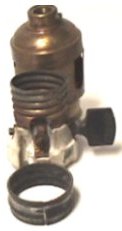
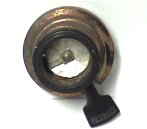
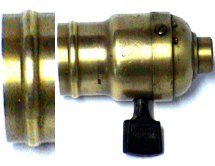
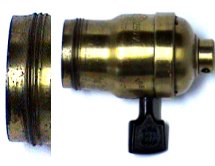
The
next type of socket shell liner
shown in the second picture, was a small ring that fit into
the end of the socket tube. Many
times this liner will either be missing, or has moved it's
way up and is resting below the bottom of the socket material.
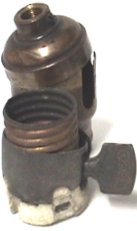
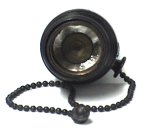
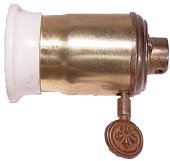
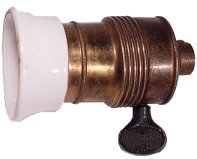
The third picture (pre-1900) is a hard ring with a ridge that
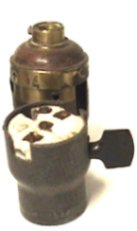
fit tight into the inside grove of the shell bead. The next
two pictures (post 1900) show the progression to the full
insulating cover.
|
Click
Here To Enter The National Electrical code Section
|
|
|
DATING BY MICA
History Of Use
|
| History
Of Mica Insulation |
Westinghouse
|
Bryant
|
Hubbell
|
| While
not all socket manufactures used mica as an insulator, most
all of those that did stopped using it by the year 1910. For
dating use, it would be a safe guess that any socket containing
mica is a pre-1910 manufactured socket. |
|
|
|
|
|
|
|
DATING BERGMANN / EDISON SLITS
History Of Use
|
| History
Of Slits |
Once
in a while you will come across socket threads with slits cut
into them. These were made to help hold the bulb in place and
not vibrate loose. The original patent for these slits was applied
for on October 18th, 1889 by the Edison Lamp Company. The patent
was approved on April 15th, 1890 and assigned patent
no. 425741. This invention can be a great tool for proof
of an early EGE socket. This is because Edison/Bergmann merged
into Edison General Electric in 1889, and fiber stopped being
used in 1890. If you have a socket that is marked Bergmann but
has the slits, it would be right at the time that this patent
was applied for. If you have a fiber socket, in a shell marked
EGE and it has these slits, it would be right at the time of
the merger.
After the next merger in 1892, G.E. continued using these slits
on their sockets until 1895 and then only on some selected sockets
after 1895.
This slits are now known after so many years to cause problems.
Two things to watch out for would be cracking below the bottom
parts of the slits and broken or cracked hard rubber collars,
which is common on these sockets once the base is cracked.
A perfect EGE socket slit is shown above to your right, and
a cracked one center on your right.
Also note
that these slits were used on some Edison based sockets made
by some other manufacturers such as EE&S.
You can also find these slits on some post 1900 items that were
licensed to use the Edison base. A good example is the Westinghouse
to Edison adapter shown on your right (patent
796922).
You can see more examples of slits in the Bergmann
ID section as well as my 1900 lighting time table under
Hubbell where slits were used on a pre-1900
Hubbell socket.
|
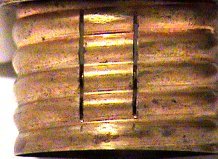
Perfect Condition |
|
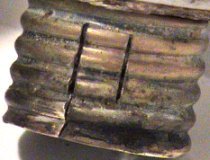 Crack Caused
By Slit
Crack Caused
By Slit |
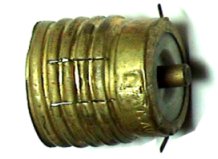 1905 Adapter
Using Slits
1905 Adapter
Using Slits |
|
|
|
|
DATING BY SHELL MARK C.P.
C.P. vs WATTS
|
| May
1st 1910 - Change In Standards |
Pre
1910 Socket Marked 50 C.P.
|
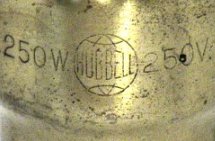
Post
1910 Socket Marked 250W
|
On
May 1st 1910 an official change was made when it comes to how
lamps were rated. A new wattage system was adopted and the older
candlepower rating was abandoned. This marks the year that sockets
no longer were stamped with the C.P. mark and the year that
sockets began being marked with WATTS.
|
|
|
1899
marked the year that the NEC began requiring all socket shells
to be marked with the CP rating. This leaves us a common date
range that if a socket is marked with the CP rating it will
likely be within the date range from 1900 to 1910. If it is
marked WATTS it was manufactured after 1910.
If there is no mark on the socket at all it is a pre 1900 socket.
(See the national code standards section NEC) |
|
|
|
|
DATING BY SOCKET TUBE
Bead / Rib Vs UNO Threads
|
|
Ornate
Bead / Rib
|
Post
1900 Shell
With Bead / Rib
|
Early
European Shell
No RIB or UNO
|
|
|
|
|
|
Pre-1900
Long Shell
With Bead / Rib
|
Post
1914 Shell
With UNO Threads
|
Later
European Shell
With Ornate
Bead
/
RIB
|
|
|
|
|
Pre-1900
Ornate Shell
The first picture shown above is of the ornate beaded shell
(extra short). There were two styles of this shell. The first
showing up in 1886 which was about 2.2" from the top of
the cap to the bottom of the shell. The shorter shell measured
2.0" and most times is only noticed if you stand the two
sockets next to each other or measure it. On this site these
will be referred to as ornate short and ornate long. The ornate
short is a newer style which is thought to have first started
being used by EE&S (Electrical Engineering and Supply Company
of Syracuse, NY). EE&S was first announced in Electrical
World in 1891. About this time Thomson-Houston also came out
with an ornate short shell. Because these T-H caps were slightly
different in size, they were stamped close to the set screw
with either an S (for short) or L (for long). This provides
us a narrow date line to identify regular long sockets marked
with the T-H 1887 patent date that were manufactured much later
and close to the time that they merged with the General Electric
Company in 1892. There were not as many of these sockets made,
which makes these T-H stamped socket shell caps much more rare.
Pre-1900 Long Shell With Bead / Rib
The first illustrated mention of the regular Pre-1900 long shell
is the 1888 Westinghouse catalog.
This style shell lived on being used by many different manufactures
until the design needed to be changed in 1900 which would accommodate
the new insulation requirements contained in The National Electrical
code of 1899.
Post 1900 Shell With Bead / Rib
G.E Co. uses a similar design shell starting in 1895 (first
seen in a catalog 1897), but for the most part this beaded shell
design began being used by most all manufactures in and after
1900.
Post
1914 Shell
With UNO Threads
UNO threads came out in 1914 and by the year 1915 was being
used by virtually all socket manufactures.
This is with exception to smaller candle sockets and larger
mogul sockets, which normally would not use shade rings.
European
Shells
Since these European
shell designs are out there,
we have added them to this section to avoid confusion by those
that may come across them.
|
|
|
|
|
DATING BY CATALOGS
Dated Electrical Catalogs,
Bulletins,
Distributor Catalogs, Magazines, Ads & Other Printed Material
|
|
Trade
Catalogs
|
Socket
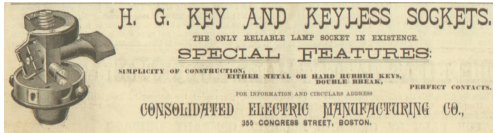
Ad - Electrical World Magazine December 27 1890
|
|
|
|
|
One of
the best ways to date items, is to look back into history
and see when those items were being sold.
By collecting or viewing catalogs, it is like walking through
and shopping in the stores of the past.
When browsing catalogs, you can also benefit yourself in the
following ways:
Dating Items
Being able to see from the pictures in the catalog that your
item is available one year and not the next. This can tell
you not only what year the item came out, but what year it
stopped being sold to the public.
Dating
Design Changes
Because the pictures in these catalogs and ads are most times
ultra detailed, you are able to see what year minor changes
to an item took place. While patent applied for dates are
a good source of information for the basic release date, patents
are not updated when small changes to the construction are
made.
Becoming
Aware Of Items
In many cases you will archive items that you find in the
catalogs that you never before even knew existed. You can
now be on the look out for the item knowing that it truly
exists, and now even know what it looks like.
Identification
Of Unsigned Or Unmarked Items
As you browse trade catalogs, you will now see all of the
items that each company made. Many of the smaller or common
items went unmarked. By looking at the different catalogs,
you will be able to identify which makers made what items.
Many of them have small differences that can be noted for
identification.
In this
section you will find many different kinds of printed material.
We have done our best to sort this material in a manor that
would be user friendly to the viewer.
This section has a Catalog
Database (now working on sockets, then on to shades, insulators,
fans, etc.)
You can
track items using key words or company part numbers to see
when the item first came out, and then the last catalog it
was found in. This can give a good idea of a date range on
a vintage item.
You can
use wild card searches using the *
|
Click
Here To Enter The
Catalog
Section - Working on sockets section now - welcome in...
|
|
|
DATING BY PATENTS
The Patent Research Area
|
|
|
|
|
|
|
|
|
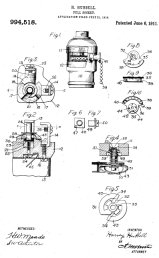
This
patent section has been made for easy browsing. We have linked
each patent to the patent office tiff files, as well as putting
the best parts of each patent drawing for identification into
a gallery view for you as shown above.
|
 There
are some things that you will need to watch for when
using patents for dates, but for the most part when
it comes to most items, you are safer using this section
rather then going by only the dates found on items. There
are some things that you will need to watch for when
using patents for dates, but for the most part when
it comes to most items, you are safer using this section
rather then going by only the dates found on items.
- There
are some cases where old or incorrect dates were used
on shells:
This could cause you to date the item incorrectly
with the date on the item when it was in fact a much
later patent.
-
Cases of 'patent applied for' taking up to several
years to get approved:
This could cause you to date the
item many years newer, when in fact it was sold to
the public many years earlier while in the patent
applied for stage. Keep in mind that in these cases,
it can help date it older if the date is not on the
item, but newer if it is.
- Cases
where parts or methods are being used already, but
not actually described in an official patent until
years later:
An
example of this would be where a feature is displayed
in a diagram drawn for one patent in 1906. It already
may have been a common method used on this types of
item, or something used on another item type already
for many years. Now lets say in 1910 the method or part
is actually described in the writing of the patent.
Because it is now being described it has now become
part of the patent, which is far different from just
being included in a previous drawing. It is sometimes
helpful to analyze the patent drawings for what was
common in the era or in the artists mind while drawing
the pictures.
An example of incorrect dating:
The
patent dates seen on some Bryant socket shells are patents
for the shells only, not for the switches inside.
These socket shells were used first for their turnkey
switches and in later years both the turnkey and pull
chain style switches. The first Bryant pull chain switches
first started coming out around 1904/1905.
Also
these same shell patent dates were used on later examples
of shells, such as when the shell was updated and started
using UNO threads. So you can have a socket that is
marked with a patent date of 1907, but has UNO threads
which where not used on sockets until 1914. This was
seven years later.
An example of a common mistake, is for someone to read
the 1907 patent date on this later shell model and then
date their lamp at 1907.
|
|
Click
Here To Enter The Patent Section - NOW UNDER CONSTRUCTION
or here for old Hubbell
research
|
|
|
DATING BY CHAIN FINIALS
History Of Use
|
|
|
|
|
|
|
|
1899 to 1901 |
1899 to 1901 |
1899 to 1901 |
1901 |
|
|
|
|
|
|
|
1901
|
1901 to 1904 |
1904 to-
1909 |
 Post
1909
Post
1909 |
Post 1909 |
|
|
|
|
|
|
 1911
to 1928
1911
to 1928 |
 1911 to
Post 1930
1911 to
Post 1930 |
 Post 1911
Post 1930
Post 1911
Post 1930 |
Post 1903 - 1910 |
1914 - Post 1921 |
|
|
|
|
|
|
1914 to 1928
|
|
 1917
to Post 1952
1917
to Post 1952
|
1923
to Post 1929
|
1923
to Post 1958
|
|
|
|
Post 1926 |
Some
As Early As 1910 - Most Used Until Post 1958
Click
Here for Luminous
Finials - WAITING CONSTRUCTION (Please check back)
|
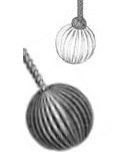
1896 Silk Tuna line Ball
First used by Hubbell for the first pull socket which was
patent number 565541.
Bryant sold this Hubbell design from 1897 to 1901. Bryant/Perkins
continued using this silk tuna line ball finial on a Perkins
switch, until it was finally replaced with the Bryant snaplock
ball in 1921.
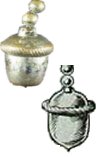
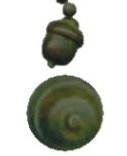
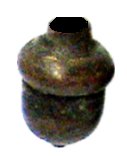
1899
Hubbell Ornate Acorn
This larger,
heavy, solid, ornate Hubbell acorn was short lived. It was
the first brass acorn that was used on pull chain switches.
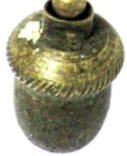
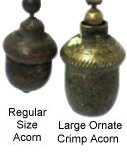
1899 Hubbell
Large Ornate Crimp Acorn
This acorn differed slightly from the above and was made as
a replacement acorn for the above.
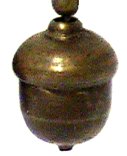
1901
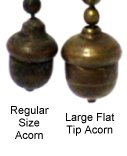
Hubbell Large Flat Tip
This acorn
was also a solid heavy acorn. This was the first beta design
before using the smaller non-ornate acorn shown below.
1902
Hubbell Flat Tip
It is easy to tell the difference between these and other
acorns, because this acorn is heavy and solid while others
are hollow and weigh almost nothing. The tip at the bottom
is round and does NOT come to a sharp point at the end. This
rounded tip is flat at the bottom as if it was hammered and
is almost always sharp to the touch around the edges. This
tip sticks out almost 1/16th of an inch.
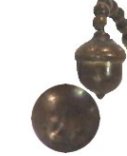
1904
Hubbell Point
Tip
These are
hollow much lighter finials with a distinct point at the end.
These do not have flat tips at the bottom like those before
1904 or the dented tip of those after 1909. The point is sharp
and distinct and normally sticks out almost 1/16th of an inch.
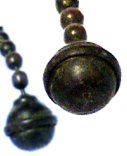
1909
Bryant
Old Style Ball
This ball
finial was used by Bryant starting in 1909. Bryant first started
using the point tip acorn on their pull sockets in 1907. Then
starting in 1909 switched to this ball finial until changing
to the tassel many years later. This ball finial was used
on many other sockets starting in the year 1912 and as late
as 1952 by GE Co., P&S, Benjamin, Arrow and many others.
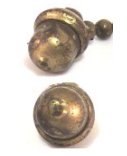
1909
Hubbell Punch
Tip
These finials
are the most common seen today, coming from the more common
Hubbell sockets without the chain guide attached to the shell.
The acorns are hollow just like those above, but without with
a distinct point at the end. These finials have more of a
dented or punched out tip. The point is not sharp or distinct
at all and normally sticks out just enough to give it the
form and appearance of a tip.
1911 Hubbell
Crimp Acorn
This acorn was used and sold in Hubbell Catalogs from 1911
until 1928 as a replacement acorn.
1911
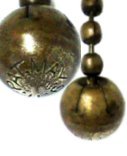
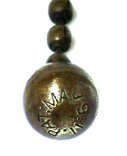
King's Pat. Chain Ball
This ball finial has a patent date stamped on the bottom of
May 9, 1911 which is patent number 992,001 applied for by
George A. King of Scovill Manufacturing Co. on Feb. 7th 1911.
It was first made as a new invention of a replacement finial,
but within only a couple years was licensed by GE, P&S,
Arrow, Benjamin, etc. and found it's way onto many of the
major sockets and fixtures of the time.
Shortly after this design a new finial with a hole in the
bottom came out so that it could be easily used with a string
in place of the beaded chain.
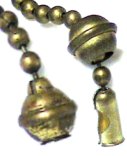
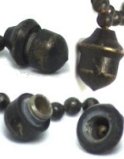
1903Hubbell
Removable
These acorns
unscrew. Like many other examples of Hubbell's prototypes,
the invention was not patented until the final product was
decided on. In this case the other removable acorns shown
below.
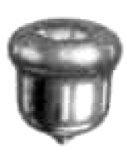
1914
Hubbell Press-In
This acorn was sold in Hubbell and other catalogs as a replacement
acorn until 1921. It is much like the 1911 ball by King in
the way that it attaches.
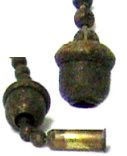
1914
Hubbell Removable (Snaplock)
This chain on this acorn is removed by griping the last ball
going into the top of the acorn and pushing down lightly.
The slip tube will then slide out of the bottom for easy removal.
This acorn is called the "snaplock" in the Hubbell
Catalogs. It is also the acorn of choice used for silk line
cord.
1915
Bryant Snaplock Ball
There is
a Bryant patent for this Pat No. 1,083,821 applied for 10/28/1913
approved 01/06/1914. Another patent by Bryant 1,173,896 was
filed 03/09/1914 approved 02/29/1916. Another patent by George
A. King of Scovill Manufacturing Co. on 12/22/1923 and approved
on 01/13/1925.
By 1918 P&S and Benjamin were also using this finial design,
1921 Levloier, 1928 G.E, and was used as late as 1952 by Arrow.
|
1913
Bryant
|
1914
Bryant
|
1923
Scoville
|
|
|
|
|
If the
finial does not have the slits on the bottom of the base,
it is a 1914 Bryant.
If the finial has the slits, but no push down case for the
ball to fit into, it is a 1913 Bryant
If the finial has the slits and the chain ball case, it is
the 1923 Scoville.
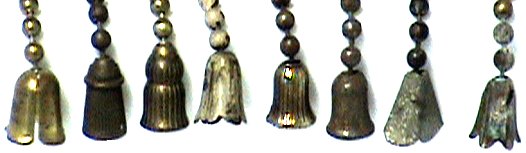
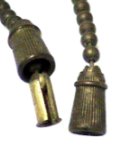
1917
Snaplock
Tassel
This was another Bryant design that was used by them early,
but ended up replacing the ball finial as early as 1930 and
continued to be used post 1948 at which time they were mostly
using the thin cheap snapin tassels. Arrow used this design
as late as 1952.
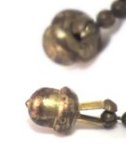
1923
Hubbell
Removable Acorn
Hubbell
used these removable acorns starting in 1923. This finial
was at first only used for hard to get to areas such as a
candle socket or cylinder lamp. Many of these hard to get
into areas were only a few inches from the hole to the socket.
However these became quite common and began to be used on
newer sockets as a standard by 1927. Soon after only the tassel
version was offered that is shown below.
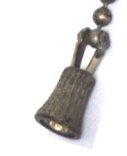
1923
Hubbell
Removable Tassel
Tassels using this method started being offered late in 1923
though they became more common during the indicating pull
socket era of 1926 to 1930. This tassel was used and sold
as a replacement as late as 1958 as shown in the Hubbell catalogs.
To see if you have the slide in clamp model acorn or tassel,
you can squeeze the clamp tight around the ball with your
fingers and then pull up softly. If it is the this removable
model it will slide upward as shown in the pictures.
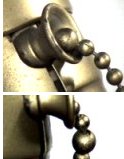
Post 1926 Hubbell Indicating
Chain
Indicating pulls started being used in 1926 and shown in the
patent for the Indicating Pull Socket patent no. 1736285.
The Indicating Pull Socket was one of Harvey Hubbell's last
inventions. He died on December 17, 1927. This patent was
approved Nov 19th 1929 after his death. His son Harvey Hubbell
III, succeeded him as President of Harvey Hubbell, INC.
The
indicating pull worked by crimping a larger brass ball cover,
over one of the pull chain balls close up to the switch.
The switch was designed to hold back some of the chain in
the "off" position and release it in the "on"
position. Depending on how close that you put the ball to
the switch, it could cause the ball to be appear hidden
when the switch was off and visible when turned on.
Even
though you may find these indicating chains on non-indicating
sockets, the chain (if factory installed) dates your item
to post 1926 which is when the pull was invented.
Miscellaneous
Tassels
While it would be hard to date every tassel that ever came
out, it would be a good practice to just use common sense.
If it is a cheap tassel it is likely a cheap undesirable
socket. Most of these do not use screws but rivets in the
later years when most companies were more concerned with
the cost of making the sockets rather then the quality of
the socket.
Luminous
Finials
For more information or pictures of luminous finials enter
this section.
Luminous finials started being offered about 1914 and were
still being sold in catalogs as late as 1937
|
|
|
|
� COPYRIGHT ALL RIGHTS RESERVED
|