|
Learning
Tools And Research Material
|
User Forums
Post pictures of your items and ask questions or just
learn from reading the posts from others
Ad
Database
View or upload ads from antique magazines
Bulb
& Socket Bases
View images of the most well known bulb and socket bases
Patent Utilities
Patent
Linker
Lets You Pull Up Any Patent PDF File Or Link One Directly
To Your Web Page
Group Patent Dbase
Lets
You Download The First Page Patent Picture Of Every Patent On A Single
Day To View On Quickly Your Local Computer
MultiView Search
Lets
You Search For Patents Using Advanced Methods And Provides Hyper Links
To The Patent Office And Google Patents |
|
|
I
have not had much time to get many items in the forsale area below.
Please keep checking back as I will start adding more items soon.
Items
For Sale
Cord
Balls & Adjusters
NEW - My cord
pendant adjuster project, as well as a good history about them.
|
|
Socket
& Electrical Manufacturer's Items And Their History
|
GECO
Sockets
NEW
- This section will allow you to date
and learn how to tell one GECO socket from the other.
Hubbell
This is where this site started from. Since this page
was done, there has been much more Hubbell history and information
found which will make for a complete redesign of this page and section
in the soon future.
Hubbell Patents
This section has some early patent research on Hubbell.
It is mostly complete with only a few missing patents which will be
added in when this section is re done into the new format
Wheeler Reflector
Co.
NEW - A history of The
Wheeler Reflector Company and tips on how to tell if mirror has been
replaced on a shade
Other Manufacturers
This section is a lot of incomplete
work and will be updated shortly. For now it serves to give you some
extended information on some companies, but will be a much better
tool when it is complete
NEC
This section is everything you ever wanted to know about the National
Electrical Code (NEC) but had no one to ask. Downloads of old NEC's,
meetings and much extended information is provided.
|
|
Tutorial
And Early Lighting History
|
|
The Lighting Time Table
To
read the entire tutorial, you can just click on the first link and
then continue to the next section at the bottom of each page. Or,
you can select links below of interest to you.
PRE 1900 SECTION
Overcoming Obstacles
About Early Electric Lighting, Generators, Arc Lamps,
The First Edison Socket, Menlo Park, etc.
The
First Fixtures
About The Start Of The First Incandescent Lighting
Fixtures
Light
Reflection
About Early Light Bulbs And Candle Power vs. WATTS
Edison-Bergmann
About Sigmund Bergmann And The Start Of Bergmann
And Company Lighting Fixtures
Lighting
Break Down
A Quick Break Down Of Different Lighting Time Periods
Styles
1881 to 1884
Bergmann Fixtures And Styles
Other
Pre-1888 Styles
About Early Companies That Sold Lighting Systems
And The Fixtures That They Sold With Their Lighting Systems
The
U.S. Elect. Co.
The United States Electric Company History And Early
Items
The
Brush Elect. Co.
The Brush Electric Company History And Early Items
Thomson-Houston
The Thomson-Houston Electric Company History And
Early Items
Westinghouse
About The Westinghouse Manufacturing Company History
And Early Mergers
Mid
1880's Styles
About The Start Of Electrical Supply Houses and
how new lighting styles came about
Pre
1900 Sockets
About Early Light Sockets And How To Tell The Difference
1887
New Items
1888
New Items
1890
New Items
1891
New Items
1892
New Items
1893
New Items
1894-1896
Items
1897
New Items
1898
New Items
1899
New Items
Above are catalog items sold in different years. There is no space
to duplicate items, so only new and unique items from each year
are shown. You would need to view the catalogs for yourself to be
complete as I am only highlighting items. You can view catalogs
here.
EXTRA INFO
Victor
Shade Holder
About The Victor Shade Holder, Atwood And The Standard
Holder
I.P.
Frink 1899 Items
About
Frink & Wheeler
New
Wheeler Inverted
Three Links About Mirror Reflector Manufacturers
And Their Items And History.
Wheeler Reflector
Co.
NEW - A history of The
Wheeler Reflector Company and tips on how to tell if mirror has
been replaced on a shade
Early Desk Lamps
Some Help In Telling Them Apart
Vitrite And Luminoid
About The Vitrite Holders And Early Vitrite History
Brush-Swan Holder
About Brush-Swan Shade Holders
Cord
Balls
My cord pendant adjuster project, as well as a good
history about them.
POST 1900 SECTION
About
1900 Styles
This section covers a basic into into the 1900 section
covering information about the 1899 transition, electrical code
changes, lighting influence, sharing and licensing of patents and
then into the new section of electrical specialty manufacturers,
Electrical Specialty Manufacturers
Harvey
Hubbell
This section covers some early history periods of
pre Hubbell-Grier, Hubbell-Grier, Harvey Hubbell, Hubbell Company.
It also covers a number of items that helped change lighting styles,
Benjamin
This section covers some early history periods for
the Benjamin Electric MFG. Co, as well as a small section on Dale
and The Federal Electric Company
Dale
Federal
Electric
This post 1900 section continues to be under current
construction
Please Check Back.
|
|
|
|
| Back to Brush |
Next to Crown |
|
|
|
How
To ID A Pre-1900 Bryant Socket
|
Catalogs
and Switch Terms
In the early
Bryant catalogs there are terms used for their socket switches.
These terms are "Bryant No. 1 Key Socket" and "Bryant
No. 2 Key Socket".
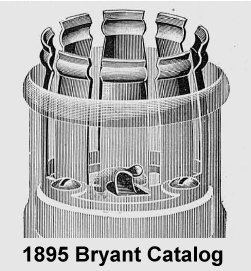
The term first started being used in the 1895 catalog when the duck
bill switch (shown below) made its first appearance on a Westinghouse
base socket and called the BRYANT "NO. 2" KEY SOCKET.
So, in the 1895 catalog we have TWO Westinghouse base turnkey sockets
-- offered as "NO. 1" and "NO. 2" which are
one each of the patent design switch and the duck bill switch.
This new Westinghouse base socket was the first socket picturing
a duck bill switch. Previously all catalog pictures were using the
first patent design of the switch.
By the time of the 1899 catalog the duck bill option was passed
on the the Thomson-Houston base sockets and termed as NO. 1 and
NO. 2 as well as a Brush-Swan base termed as NO. 2. However because
of the contact rings used and examples of these sockets on hand,
we know that the T-H base NO. 2 switch started being sold in 1897.
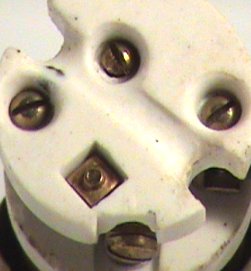
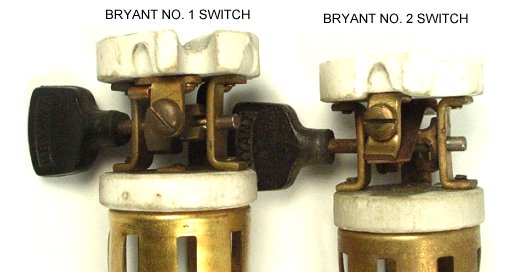
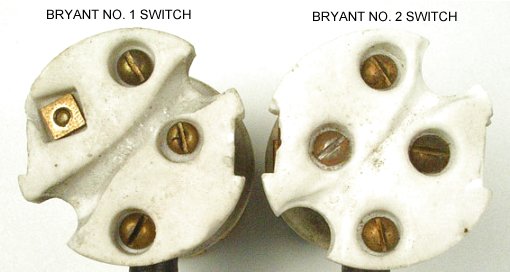
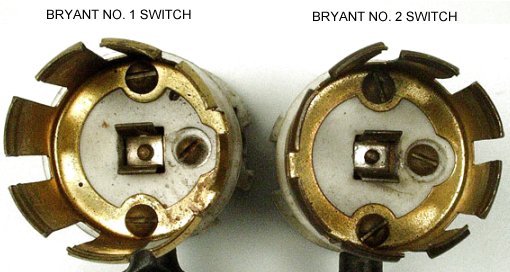
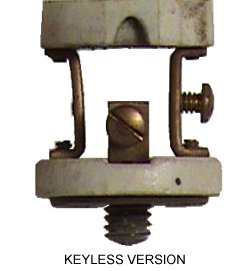
So what does all of this mean? Bryant had two socket switches, the
patent design switch shown below and hereafter referred to as Switch
NO. 1 and the duck bill design shown directly below and hereafter
referred to as Switch NO. 2.
|
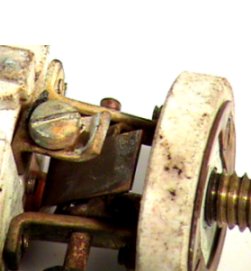
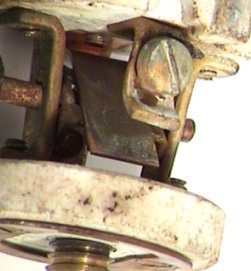
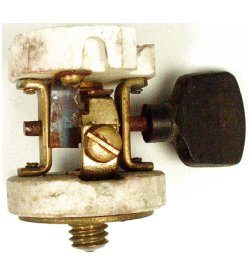
The
BRYANT NO. 2 Switch Contact
|
|
|
|
|
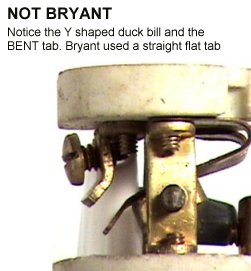
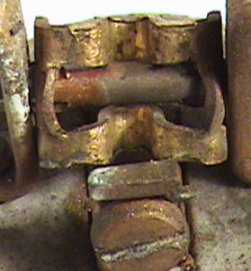
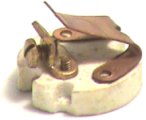 NON-BRYANT Y SHAPED BENT TAB
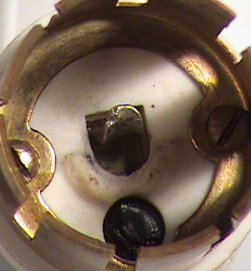
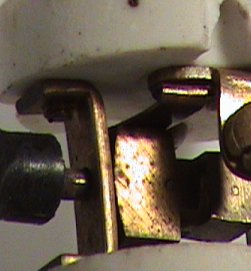
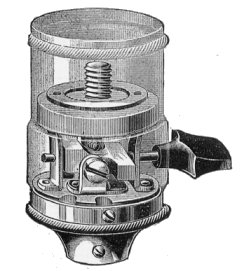
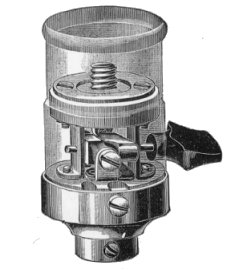
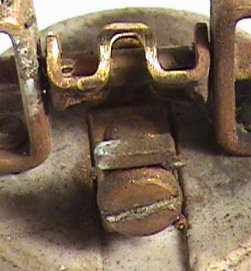
As shown above, almost all of these post 1895 Bryant porcelain
switches use this duck bill type switch mechanism. When the
key is turned, the bottom contact is forced upward (as shown
above) and makes contact with the terminal. There are no patents
found as of yet in any Bryant catalog or elsewhere for this
switch. It is clear that Bryant started using it around 1895,
but it is also clear that another unknown company was also
manufacturing sockets of this design. This mystery company
is known to use this Y shaped tab on some T-H based sockets
as well as Edison based sockets of which Bryant did not sell
at this time. It is also easy to tell the difference between
a Bryant porcelain switch and another manufacturer by the
socket shell. Bryant used a non-standard shell for their porcelain
sockets. To see how to tell the difference between a Bryant
short ornate shell, see the non-standard
shell type section.
|
The
BRYANT NO. 1 Switch Contact
|
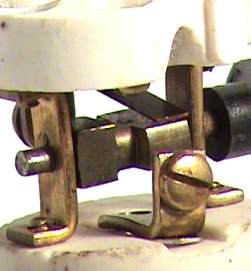
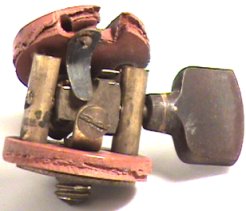 The
only exception is shown to your right and is less common
though it is found in Bryant catalogs from 1895 through
1901. The
only exception is shown to your right and is less common
though it is found in Bryant catalogs from 1895 through
1901.
This method of making contact is simple and to the point.
When you turn the key, the key post makes contact with the
tab and completes the connection. The post itself is the
conductor, unlike the switches shown above that use the
post to force the tab against a terminal to complete the
connection.
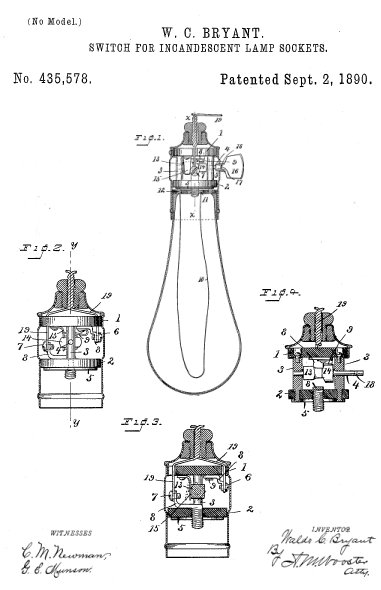
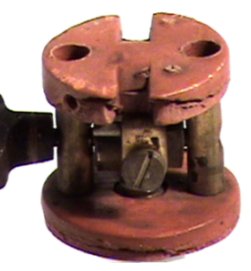
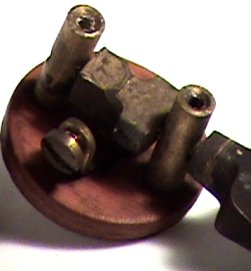
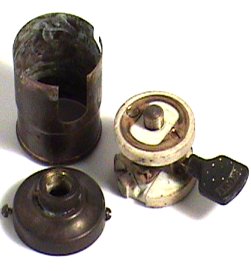
This is also the contact method that was used in the original
1890 Bryant patent. Because of this, it will be the same
type contact method used on the older pre-1891 (brick red)
vulcanized fiber switches. An example of this is shown on
the switch to your left (broken down for better viewing).
|
|
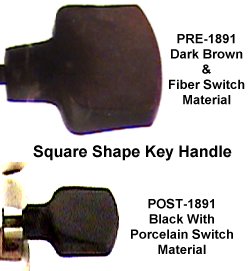
The
Key Handle
|
The
Bryant Patent Date Stamped On The Shell
|
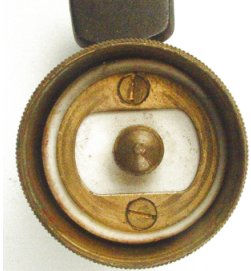
The
Contact Rings (T-H Base Sockets Only)
|
|
|
|
|
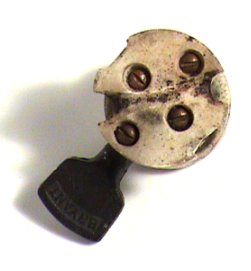
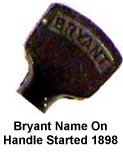 The
black handle (shown above) started being used with porcelain
switches around 1891. The 1895 Bryant catalog shows that handles
still did NOT have the Bryant name stamped on them. The 1897
Western Electric catalog still shows the unmarked handle,
while the 1898 Western Electric catalog starts showing some
of the handles stamped with the Bryant name on them. This
provides us with the date of 1898 as the start of the transition
period for this new variant. The last Bryant catalog using
these type switches was the 1901 Bryant catalog. The
black handle (shown above) started being used with porcelain
switches around 1891. The 1895 Bryant catalog shows that handles
still did NOT have the Bryant name stamped on them. The 1897
Western Electric catalog still shows the unmarked handle,
while the 1898 Western Electric catalog starts showing some
of the handles stamped with the Bryant name on them. This
provides us with the date of 1898 as the start of the transition
period for this new variant. The last Bryant catalog using
these type switches was the 1901 Bryant catalog. |
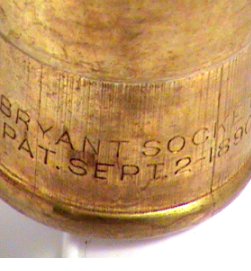
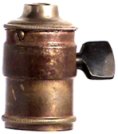 Both
the long and ornate shell designs were offered from 1890 until
1901. Some had the Bryant name and patent date stamped on
them and others did not. There does not seem to be any pattern
as to why. The new 1899 electrical code stated that the company
name and power ratings needed to be stamped on the socket
shell. Since these sockets were in the 1901 catalog, it is
assumed that these were grandfathered overstock. However,
if we are wrong, there will be signed Bryant shells of this
type with power ratings on them. If you see one, please contact
us. Both
the long and ornate shell designs were offered from 1890 until
1901. Some had the Bryant name and patent date stamped on
them and others did not. There does not seem to be any pattern
as to why. The new 1899 electrical code stated that the company
name and power ratings needed to be stamped on the socket
shell. Since these sockets were in the 1901 catalog, it is
assumed that these were grandfathered overstock. However,
if we are wrong, there will be signed Bryant shells of this
type with power ratings on them. If you see one, please contact
us. |
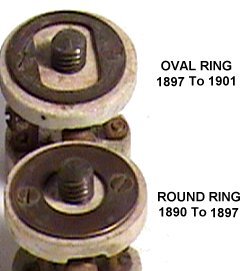
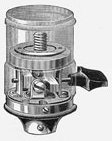 The
round contact ring shown above (after 1894) will always use
two screws to hold them in place on the T-H porcelain switches.
(note that pre-1896 porcelain and fiber switches uses two rivet
posts) The 1895 Bryant catalog still shows ONLY the round contact
ring. In an 1897 Western Electric catalog we find Bryant switches
being shown with both the round and the oval contact ring. This
shows us the transition period for this new variant, as well
as providing us with the date of 1897 as the beginning of it.
The oval ring and this type socket, is last seen in the 1901
Bryant catalog. The
round contact ring shown above (after 1894) will always use
two screws to hold them in place on the T-H porcelain switches.
(note that pre-1896 porcelain and fiber switches uses two rivet
posts) The 1895 Bryant catalog still shows ONLY the round contact
ring. In an 1897 Western Electric catalog we find Bryant switches
being shown with both the round and the oval contact ring. This
shows us the transition period for this new variant, as well
as providing us with the date of 1897 as the beginning of it.
The oval ring and this type socket, is last seen in the 1901
Bryant catalog. |
|
1891
Bryant Westinghouse Socket
|
1891
Bryant Westinghouse As Shown The Catalog
|
1891
Bryant Westinghouse Patent
|
|
|
|
|
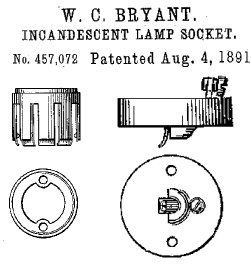
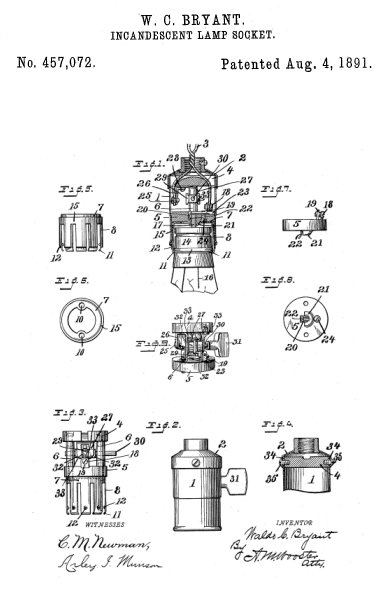
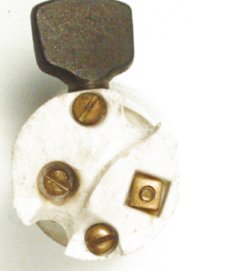
The
Bryant Westinghouse base socket was first patent applied for
March 9 1891, which also provides us with the date of the first
documented use of porcelain in Bryant socket switches. The patent
(no. 457,072) was approved on August 4 1891. The Bryant Westinghouse
design is unique in that there is only one single contact prong
to hold the Westinghouse style bulb. Other NON-Bryant sockets
use two prongs as a standard, which clamp around the center
contact pin on the Westinghouse bulb base. With this single
prong design, makes it easy to ID a Bryant Westinghouse base
socket.
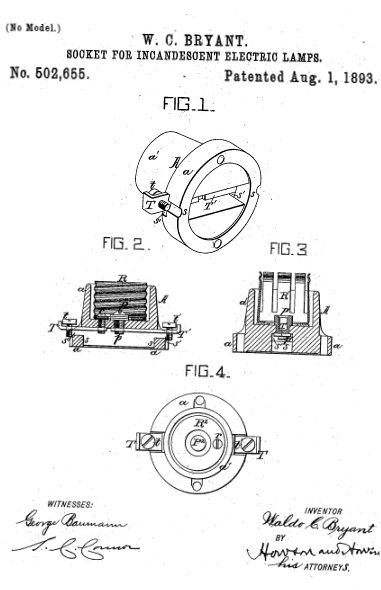
Note that Bryant patented their two prong design in May of 1893
Pat. No. 502,655 which was used on newer bases around that time.
However there may had been a lot of overstock as the Bryant
catalogs show these older switches still using the single prong
design for many years later. |
|
|
BRYANT
NON-STANDARD SHELL DESIGNS
|
|
1892
Bryant Catalog
|
Shell
Examples
|
|
|
|
|
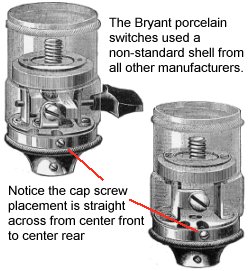
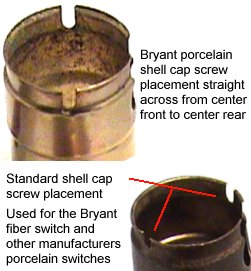
When
it comes to these short ornate shells, virtually all other socket
manufacturers placed their cap holes in the same place making it a
standard. Even though Bryant used the standard offset holes in their
fiber switch shell, when the porcelain version came out their design
changed which made their shells different from other manufacturers.
Note Many manufacturers of the long skinny shells placed the holes
straight across. These were mostly those that used the Westinghouse
Lang patent straps in the cap. |
|
Bryant
Socket Patents
|
| |
|
Socket
Patent Example No.1 (Red Fiber Switch)
|
|
|
|
|
|
Shell
And Socket Picture
|
Switch
& Tab (broken down for viewing)
|
|
|
|
|
Top
View
|
An
Inside View Of The Bryant Switch Key
|
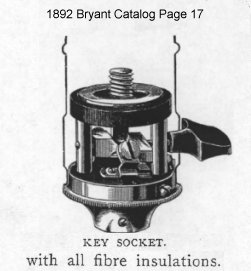
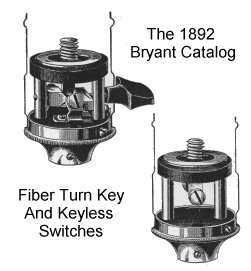
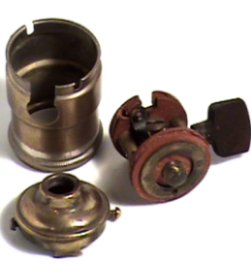
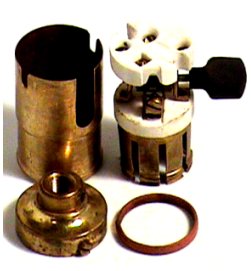
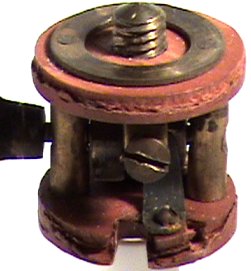 The
Bryant fiber switch shown in this section was their first socket and
started being sold close to their patent applied date of July 14 1890.
As seen in the catalog picture on your right, It was still seen and
being sold in the 1892 Bryant catalog (likely overstock). By the time
of the 1895 Bryant catalog the fiber version it is no longer being
sold and only shows the porcelain switches (round contact ring). The
Bryant fiber switch shown in this section was their first socket and
started being sold close to their patent applied date of July 14 1890.
As seen in the catalog picture on your right, It was still seen and
being sold in the 1892 Bryant catalog (likely overstock). By the time
of the 1895 Bryant catalog the fiber version it is no longer being
sold and only shows the porcelain switches (round contact ring).
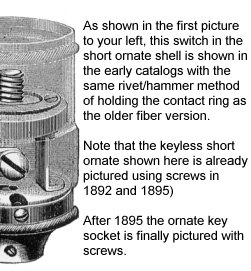
Notice the red fiber switch with the round contact ring as shown on
your left.
The ring is held by a rivet/hammered method and is not removable without
breaking the fiber. Other manufacturers used screws to hold their
contact ring.
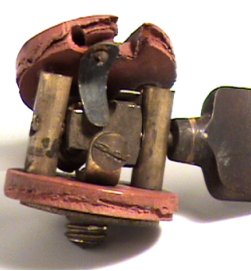
The tab shown in the picture on the left (held by one tiny screw)
is only used to help hold the switch in place when it is turned into
the on and off positions and is not needed for any electrical contacts.
I note this because this tab is normally the first and only part likely
missing on aged switches in poor condition.
|
|
Socket
Patent Example No.2 (Westinghouse Single Center Prong Contact)
|
|
|
|
|
|
Shell
And Socket Picture
|
Bryant
No. 1 Switch
|
|
|
|
|
Top
View
|
Single
Center Prong Contact
|
|
|
Socket
Patent Example No.3 (Westinghouse Base Dual Prong)
|
|
|
|
|
|
|
|
|
|
|
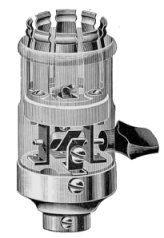 Bryant
applied for their two prong patent design in May of 1893 Pat.
No. 502,655 (shown above) which was used on newer bases around
that time. However there may had been a lot of overstock as
the single prong design is still shown being offered in the
1895 Bryant catalog on this No. 2 Bryant socket. Bryant
applied for their two prong patent design in May of 1893 Pat.
No. 502,655 (shown above) which was used on newer bases around
that time. However there may had been a lot of overstock as
the single prong design is still shown being offered in the
1895 Bryant catalog on this No. 2 Bryant socket.
|
|
|
Socket
Variant Example # 1 - Round
Contact Ring -
Bryant No. 1 Switch - 1890 to 1897
|
|
|
|
|
|
|
|
|
|
Socket
Variant Example # 2- Oval
Contact Ring -
Bryant No. 1 Switch - 1897 to 1901
|
|
|
|
|
|
In an 1897 Western Electric catalog we find Bryant switches
being shown with both the round and the oval contact ring.
This shows us the transition period for this new variant,
as well as providing us with the date of 1897 as the beginning
of it. The oval ring and this type socket, is last seen in
the 1901 Bryant catalog.
Note that this is a Bryant No. 1 switch. If this socket had
the round contact ring, the date range would be from 1890
to 1897.
|
|
|
|
|
|
Socket
Variant Example # 3- Oval
Contact Ring -
Bryant No. 2 Switch - 1897 to 1901
|
|
|
|
|
|
|
|
HOW TO DATE T-H BRYANT PORCELAIN SOCKETS
Round
Ring No. 1 Switch - 1890
to 1897
Round Ring No. 2 Switch - 1894
to 1897
Oval Ring No. 1 Switch - 1897
to 1901
Oval Ring No. 2 Switch - 1897
to 1901
Above with the name BRYANT on Key Handle
1898 - 1901
The short ornate porcelain switch if using screws to hold
the round contact ring - Post 1896
|
|
|
|
| Back to Brush |
Next to Crown |
|
|
� COPYRIGHT ALL RIGHTS RESERVED
Contact
Us - Send Private Email To the Admin
|