|
The Lighting Time Table
A Walk Through History & A Display Of Rare Antique
Lighting
|
| |
|
FIXTURE
STYLES FROM THE 1900's
|
THIS PAGE WAS
CONTINUED FROM HERE
http://antiquesockets.com/lighting-timetable3.html
|
1900
- 1921 - INCANDESCENT
LIGHTING STYLES
|
Well we made
it into 1900 - I do not think I need to inform anyone that putting
this page together is a lot of work and has taken up a major part
of my free time (of which is almost non existent these days).
This section is by far the hardest section to put together seeing
that so much happened during these years.
I will try my best to cover the basics for you, which should provide
a good basic understanding of other antique and vintage lighting
styles that you will come across.
As you have already learned, early electrical incandescent inventions
and fixtures progressed slowly from 1879 until about 1890.
Around 1890 there were some standard changes (such as porcelain
insulation) and other factors such as industry growth in the area
of generators, power plants, metering, etc. The public view towards
electricity had also become more rooted in it's favor because of
years of hard fact being published. This aided in silencing the
early disinformation spin doctors (that worked for the large gas
companies) that were spreading false information against electric
lighting. It was also starting in 1890 that many electrical parts
manufacturers and supply companies came to life and pushed new electrical
inventions up to this point in time, the year 1900.
There was also an organized effort on the part of big business to
push us into the electrical era that we now live in.
There were many organizations formed which worked together, setting
goals and bringing things to pass (for a good example of this read
the NEC section
on this site).
You would think that when a book became available on the market
that explained simple facts about lighting, that it originated from
someone that decided to write a book and share their knowledge.
While this is true in many cases, it is also true that some were
all part of a plan developed by a committee in a lighting organization
to help further business development for incandescent lighting.
A good example of this is shown below in the book Standard Lighting:
|
Compiled
By A staff Of Experts
Endorsed by the Lighting Department of the Joint Committee
for Business Development in the movement to
"Electrify" and by the Society for Electrical Development.
The
movement for Business Development is being promoted by the
following national organizations:
National Electric Light Association;
Electrical Supply Jobbers' Association;
National Association of Electrical Contractors and Dealers;
National Council of Lighting Fixture Manufacturers;
Lighting Fixture Dealers' Society of America;
Illuminating Glassware Guild;
Illuminating Engineering Society;
Electrical Manufacturers' Council;
The American Institute of Electrical Engineers.
|
This is only
one example out of many to show how it was big business, that steered
and guided us into our electrical era. All of these organizations,
societies, councils and associations had some big names as members
and board members and was only one of the methods used to to expand
growth.
The year 1900 also marks the year of a new period of growth, which
in only five years well out weighed the growth in the previous 20
years. I hope that this helps you to understand that to even think
about attempting to cover the years 1900 to 1921 here on this web
page (even far from complete), will not happen as easily as the
earlier years.
After 1906 and up to 1910, things change so rapidly that it would
be almost impossible to document in any detailed fashion.
By 1921 There were so many new inventions, lamp manufacturers, electrical
supply houses (and catalogs), wiring specialties businesses, jobbers,
etc., that we are talking multiple thousands of items through the
years.
Then added to this, we have different manufacturing methods of items
such as glass, lead, copper foil, hammered copper, etc., etc.. Then
lighting styles and periods (mission, deco, etc), the rise and fall
of now well known makers (tiffany, handel, miller, whaley, morgan,
duffner, wilkinson, etc., etc.). Those that had started as corner
lamp shops or reflector companies (frink, wheeler, etc.) that had
made their livelihoods and then retired (In some cases sold or handed
down to the family and still alive today as a family owned business
such as klem).
Now keep in mind that most had pamphlets and catalogs through the
years, which means new and changed items in many cases yearly. Trust
me when I say that I can not even include a small percentage of
the material that I have here on this page without making it a lifetime
project.
It is for these reasons that this new 1900 to 1921 section will
be designed after a much different style and cover hit and miss
on different types of lighting items, as well as Electrical Specialty
manufacturers that had a direct effect on lighting styles (see "Electrical
Specialty Manufacturers Flourish" below).
THE TRANSITION OF 1899 TO 1900
This is an awesome time frame. There is so much history to be found
in this one single year, and then following into the early years
of 1901 to 1906 complete the transition of many key historical events
and new lighting styles.
New Electrical Code Changes Styles
The first thing that came about were major changes to the electrical
code that was to go into effect April of 1899.
By 1900 the early socket shells (short
ornate and long skinny) were no longer made because they did
not meet the new code requirements for full
insulation. While it took a few years to completely get rid
old stock, most new fixtures being sold in and after 1900 were sold
with the new fatboy
style sockets.
Lighting Influence
It is note worthy that different styles or movements such as "Victorian
Style Lighting", "Art Nouveau" and "Arts and
Crafts" all play a part in this time frame, as well as some
examples of "Eclecticism" (pronunciation)
because of early jobbers assembling less expensive fixtures that
could be termed as 'adaptations', trying to capture the spirit of
some early styles.
Sharing And Licensing Patents
In the early days of lighting inventions, close guard was kept
on products as a general rule.
You would rarely find multiple manufacturers of one item or invention.
In like manner in the early days you would also commonly find a
note of a catalog company being a "Sole Distributor" of
one single item. While this worked in the early years, as more competition
and inventions began to flourish, it was more rarely seen. Most
all of this seems to change in about 1897 when General Electric
became less concerned with patent wars and began to target more
on bringing everyone together. By 1900 you start to see more licensing
taking place which makes this section and identifying different
lighting items much more difficult. An example of this would be
two inventions which started being licensed by other manufacturers
about the same time frame which was Bryant's patent for their wrinkle
shell and Hubbell's patent for their detachable chain guide.
Within only a few years virtually all manufacturers (Arrow, Weber,
P&S, H&H, GE, Paiste, etc., etc.) were using Bryant's wrinkle
shell together with Hubbell's detachable
chain guide.
Before long many inventions and items were being manufactured by
a mix of different manufacturers, or ordered in quantity and then
used along with their own styles and inventions. I do not need to
tell you how confusing this can sometimes be when trying to ID an
item.
Electrical Specialty Manufacturers Flourish
In the previous years 1890 until 1900 electrical parts manufacturing
companies flourished. The major part of their success was their
electrical catalog distribution system and catalog turnkey businesses.
The year 1900 marks the point in time that more specialty manufacturers
started flourishing. During this time, many new wiring specialty
businesses started popping up and joined the frenzy. Electrical
and Wiring Specialty businesses had such an impact that large catalog
distributors added "Wiring Specialty" or "Electrical
Specialty" sections to their catalogs containing selected items
from different manufacturers.
Not all of these specialty businesses had a direct effect on lighting
styles in a large way, but I can not help from bringing up the first
that I will cover which I feel had the largest impact, Harvey Hubbell.
|
ELECTRICAL
SPECIALTY MANUFACTURERS - HUBBELL
|
PRE HUBBELL
COMPANY - PRE HUBBELL-GRIER (1895-1901)
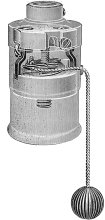 It
was Harvey Hubbell that had invented the first successful pull (string)
socket. His first pull socket was manufactured in 1895, patented
in 1896 and sold by the Bryant Electric Company as early as
1895. Later (in 1897) the socket (with an Edison base) also started
being sold by the General Electric Company in their
catalog. It
was Harvey Hubbell that had invented the first successful pull (string)
socket. His first pull socket was manufactured in 1895, patented
in 1896 and sold by the Bryant Electric Company as early as
1895. Later (in 1897) the socket (with an Edison base) also started
being sold by the General Electric Company in their
catalog.
Hubbell has got to be the best example of an electrical specialty
manufacturer that started electrical specialties with only one single
item; and then to overcome all obstacles and survive into our present
day as one of the largest electrical and lighting manufacturers
in the world.
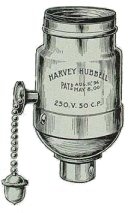 Starting
with the pull "chain" socket (1899
to 1900), Hubbell had a HUGE effect on lighting and fixture
styles throughout all of these time periods. He also continued having
an effect with many of his other unique inventions such as his unique
type of shade holders, early clusters, use of acorn finials, pull
chain extenders, etc. Starting
with the pull "chain" socket (1899
to 1900), Hubbell had a HUGE effect on lighting and fixture
styles throughout all of these time periods. He also continued having
an effect with many of his other unique inventions such as his unique
type of shade holders, early clusters, use of acorn finials, pull
chain extenders, etc.
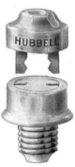 Not
only did Hubbell have an effect on styles, but how electrical devices
of every kind were used. His
many inventions and industry firsts can be equivalent to books
of today like the "For dummies" type of books being written
today. It was his inventions that made even plugging in an electrical
appliance a simple thing with the invention of the first separable
attachment plug. (And
here) This was before we had the common wall socket of today. Not
only did Hubbell have an effect on styles, but how electrical devices
of every kind were used. His
many inventions and industry firsts can be equivalent to books
of today like the "For dummies" type of books being written
today. It was his inventions that made even plugging in an electrical
appliance a simple thing with the invention of the first separable
attachment plug. (And
here) This was before we had the common wall socket of today.
(Note that the ornate acorn style shown on your right was used on
pre Hubbell-Grier company sockets)
It was not long before many other manufacturers started coming out
with their own versions of pull sockets. In the early years the
acorn finial was mostly only found on the Hubbell pull sockets,
being a sort of trademark on Hubbell sockets while other manufacturers
used different styles of balls
or tassels. The acorn finial became a trademark of quality for
high end lamp makers and within time was also used by other manufacturers.
Later Hubbell also started offering a choice of different finial
designs (1923)
and by much later years acorn finials were removed from their catalogs.
Today the original old Hubbell acorn pulls and old sockets are highly
sought after by collectors of high end mosaic lamps and other early
lighting devices.
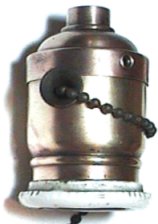 Hubbell
had been manufacturing his pull "string" socket from 1895
to 1899. Some time in the year of 1899 (likely before or close to
October, 1899) Hubbell designed a pull "chain" switch
that was Hubbell
had been manufacturing his pull "string" socket from 1895
to 1899. Some time in the year of 1899 (likely before or close to
October, 1899) Hubbell designed a pull "chain" switch
that was 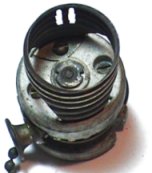 evidently
only sold for a short time by the General Electric Company. The
switch was the same basic design as the 1895 pull string switch,
with a modification for the chain in place of the string. It also
used a chain guide close to that which was later applied for patent
by Hubbell 05/17/1909 (patent
no. 956354). This new socket used a Bergmann style shell with
a new cap designed to pass the new electrical code (which allowed
room for the wireman's knot to be tied inside the shell). Evidence
of other shells for this type switch is also found (pre-Hubbell
catalog era) in a Hubbell patent applied for Jan. 28, 1901 (patent
no. 679316) where a shell is shown with a Hubbell switch in
use where the chain guide bell was not attached to the shell. (Also
note that the same shell is shown using a turn key switch). By the
date Oct. 9th 1899 Hubbell had already developed his complete pull
"chain" and socket shell designs (as shown above with
the ornate acorn finial), both being pre evidently
only sold for a short time by the General Electric Company. The
switch was the same basic design as the 1895 pull string switch,
with a modification for the chain in place of the string. It also
used a chain guide close to that which was later applied for patent
by Hubbell 05/17/1909 (patent
no. 956354). This new socket used a Bergmann style shell with
a new cap designed to pass the new electrical code (which allowed
room for the wireman's knot to be tied inside the shell). Evidence
of other shells for this type switch is also found (pre-Hubbell
catalog era) in a Hubbell patent applied for Jan. 28, 1901 (patent
no. 679316) where a shell is shown with a Hubbell switch in
use where the chain guide bell was not attached to the shell. (Also
note that the same shell is shown using a turn key switch). By the
date Oct. 9th 1899 Hubbell had already developed his complete pull
"chain" and socket shell designs (as shown above with
the ornate acorn finial), both being pre 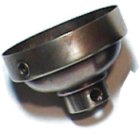 Hubbell-Grier
Company and catalog era). The points and evidence of collaboration
between Hubbell-Grier
Company and catalog era). The points and evidence of collaboration
between 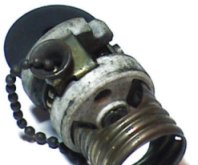 Hubbell
and GE for this socket are: Firstly, the socket shell is un mistakably
a Bergmann style fat shell body which is unmarked/unsigned which
places it before the year 1900. This shell is not found in any G.E.
Catalogs using this cap design, it was made special for this application.
The new cap gave the room needed for the wireman's knot that was
now required in the electrical code in late 1899. General Electric
was selling the Hubbell pull "string" socket since 1897,
while Hubbell did change the "string" socket by reducing
the size of the porcelain switch plates and adding insulation to
the long skinny shell in 1899, (the only known manufacturer to insulate
a long skinny shell tube) but, it still did not leave room for the
wireman's knot in the cap. Since a new design was needed for G.E.
To continue to sell pull sockets, this was likely an early solution
to their problem. Hubbell
and GE for this socket are: Firstly, the socket shell is un mistakably
a Bergmann style fat shell body which is unmarked/unsigned which
places it before the year 1900. This shell is not found in any G.E.
Catalogs using this cap design, it was made special for this application.
The new cap gave the room needed for the wireman's knot that was
now required in the electrical code in late 1899. General Electric
was selling the Hubbell pull "string" socket since 1897,
while Hubbell did change the "string" socket by reducing
the size of the porcelain switch plates and adding insulation to
the long skinny shell in 1899, (the only known manufacturer to insulate
a long skinny shell tube) but, it still did not leave room for the
wireman's knot in the cap. Since a new design was needed for G.E.
To continue to sell pull sockets, this was likely an early solution
to their problem. 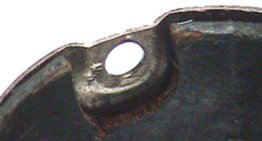 Next,
the insulated lining in this shell was oversized in thickness to
be able to accommodate the smaller switch and fit into the shell
properly. The electrical code only required 1/32-inch thickness.
This was UN mistakably designed as a quick force fit job. The switch
also uses slits on the Edison threads which is from an old 1890
(pat no.
425741) Edison/Bergmann/EGE patent now owned and used by General
Electric. The center contact on the switch is of a type unknown
and not seen on any other Edison based sockets manufactured G.E.
Or any other manufacturer from any time frame. The chain guide bell
is also of a unique design (inner and outer rim angle and hole)
not found on any other sockets through all time frames and manufacturers. Next,
the insulated lining in this shell was oversized in thickness to
be able to accommodate the smaller switch and fit into the shell
properly. The electrical code only required 1/32-inch thickness.
This was UN mistakably designed as a quick force fit job. The switch
also uses slits on the Edison threads which is from an old 1890
(pat no.
425741) Edison/Bergmann/EGE patent now owned and used by General
Electric. The center contact on the switch is of a type unknown
and not seen on any other Edison based sockets manufactured G.E.
Or any other manufacturer from any time frame. The chain guide bell
is also of a unique design (inner and outer rim angle and hole)
not found on any other sockets through all time frames and manufacturers.
HUBBELL-GRIER
COMPANY TIME FRAME (1901-1902)
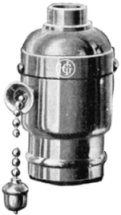
Some time close to July of 1901 Hubbell went into a partnership
with two brothers (Edward and Thomas Grier) that worked for the
Bryant Electric Company. The new company was called The Hubbell-Grier
Electric Company and the first catalog was released December 1st
1901. There were contentions early on with how business was being
done and the Greir brothers sold their stock in the company to Hubbell
and went their separate ways. By late 1902 distributor catalogs
and ads started showing "Harvey Hubbell" sockets and the
HG logo stopped being used and was replaced with the globe logo
a couple of years later.
The socket shown here and those shown on the clusters below, would
be marked/signed The Hubbell-Grier Electric Company. The logo shown
in these catalog pictures on both the sockets and clusters was only
used in the catalog pictures and not stamped on the real items.
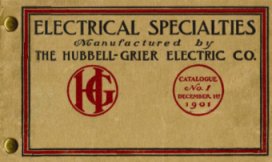 The
clusters shown below (and socket above) come from the first Hubbell-Grier
catalog published in 1901. This catalog was not made for the trade,
it was distributed to to members of the Manufacturers Association
such as Bryant, MESCO, Marshall Sanders, General Electric, Perkins,
Paiste and the Peru Electric Mfg. Co. It was also distributed to
members of the Jobbers Association. At this time Hubbell did not
sell directly to the trade, anyone wishing to make purchases needed
to contact a manufacturer authorized to sell Hubbell products. Because
catalogs were not given out to the general public at this time,
the 1901 Hubbell-Grier catalog shown above is a rare item with only
two in existence that I know of. One is currently owned by the Hubbell
family that bears the name of G. F. Hadely signed on the cover.
(Harvey Hubbell's half brother), and the other was shown in the
publication The Handel Lamps Book by Carole Goldman Hibel, John
Hibel & John Fontaine - Published by Fontaine Publishers 1999.
On page 77 of the book, the Hubbell 1901 catalog picture is used
for image page 6 and 7, and a 1904 Hubbell catalog for page 3 to
show the Hubbell logo. The
clusters shown below (and socket above) come from the first Hubbell-Grier
catalog published in 1901. This catalog was not made for the trade,
it was distributed to to members of the Manufacturers Association
such as Bryant, MESCO, Marshall Sanders, General Electric, Perkins,
Paiste and the Peru Electric Mfg. Co. It was also distributed to
members of the Jobbers Association. At this time Hubbell did not
sell directly to the trade, anyone wishing to make purchases needed
to contact a manufacturer authorized to sell Hubbell products. Because
catalogs were not given out to the general public at this time,
the 1901 Hubbell-Grier catalog shown above is a rare item with only
two in existence that I know of. One is currently owned by the Hubbell
family that bears the name of G. F. Hadely signed on the cover.
(Harvey Hubbell's half brother), and the other was shown in the
publication The Handel Lamps Book by Carole Goldman Hibel, John
Hibel & John Fontaine - Published by Fontaine Publishers 1999.
On page 77 of the book, the Hubbell 1901 catalog picture is used
for image page 6 and 7, and a 1904 Hubbell catalog for page 3 to
show the Hubbell logo.
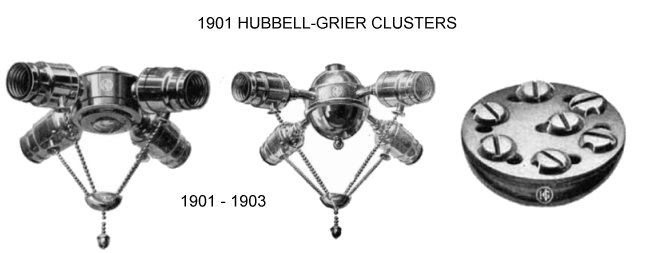
 There
are no Hubbell patents for either of the two clusters shown above.
Clusters of these types were being sold in other electrical catalogs
at this time, so it is possible that Hubbell made a deal with another
manufacturing company and was attaching his Hubbell-Grier sockets
on to third party clusters. It is also possible (but unlikely) that
a deal was made allowing Hubbell to manufacturer other owned designs.
The Hubbell Pull Cain Coupling Rosette shown above (pat.
no. 701269 Applied for Sept 4, 1901) came in 2,3,4,5 and 6 pull
chain options and was made for these early Hubbell-Grier and later
Hubbell clusters. The design of this invention was so that all lights
could be turned off or on at the same time by puling straight down
on the middle chain, or pulling to one side or the other to turn
off one or more lights. (Note that the patent picture for the rosette
patent (linked above) shows the a cluster close to the design of
the first cluster shown in the images above) There
are no Hubbell patents for either of the two clusters shown above.
Clusters of these types were being sold in other electrical catalogs
at this time, so it is possible that Hubbell made a deal with another
manufacturing company and was attaching his Hubbell-Grier sockets
on to third party clusters. It is also possible (but unlikely) that
a deal was made allowing Hubbell to manufacturer other owned designs.
The Hubbell Pull Cain Coupling Rosette shown above (pat.
no. 701269 Applied for Sept 4, 1901) came in 2,3,4,5 and 6 pull
chain options and was made for these early Hubbell-Grier and later
Hubbell clusters. The design of this invention was so that all lights
could be turned off or on at the same time by puling straight down
on the middle chain, or pulling to one side or the other to turn
off one or more lights. (Note that the patent picture for the rosette
patent (linked above) shows the a cluster close to the design of
the first cluster shown in the images above)
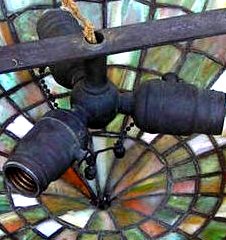 Other
methods of pulling more then one socket at a time was used and invented
through these time periods. While some professional and others more
primitive, such as one that I found on a quality high end Handel
copper foil inverted hanging lamp from about 1904. Other
methods of pulling more then one socket at a time was used and invented
through these time periods. While some professional and others more
primitive, such as one that I found on a quality high end Handel
copper foil inverted hanging lamp from about 1904.
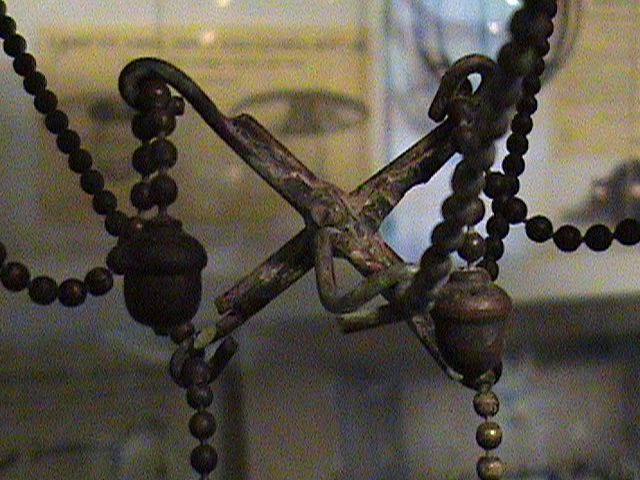
As shown on your right, this lamp used an acorn pull that comes
down through a hole. The problem was that this pull needed to operate
three sockets.
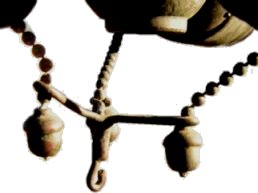 Handel
devised a method to do this by using the hand crafted sturdy wire
piece as shown on your right. Handel
devised a method to do this by using the hand crafted sturdy wire
piece as shown on your right.
This device connects to all three sockets and the middle chain that
comes down through the shade connects to the center and then drops
down through the acorn on the shade.
While Handel could have used Hubbell's Coupling Rosette, in his
case they chose to rather use their own hand crafted gizmo along
with these Hubbell sockets.
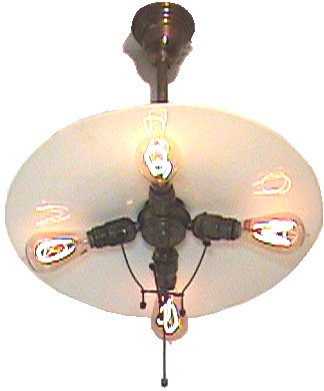 Shown
here on the left is a cluster with four Hubbell-Grier sockets that
still have their original 1901-1902 Hubbell
solid type acorns. (Andhere) Shown
here on the left is a cluster with four Hubbell-Grier sockets that
still have their original 1901-1902 Hubbell
solid type acorns. (Andhere)
When a cluster used the Hubbell Coupling Rosette, the acorns needed
to be cut off the chain.
Someone could also remove the original pull chain (with the acorn),
and use a new chain (without a finial) from the socket into the
rosette, but this was rarely done because of the fact that threading
the chain back into the sockets was a task that took some time and
experience. I remember as a young child my mother trying to fix
the chain on one of these type sockets for over an hour, then turning
it over to the man of the house to give him a try at it for almost
another hour. I remember it well because at the age of about 5 years
old I asked to let me try (which only got huge laughs and a firm
no).
On this cluster, a hand crafted soldered together copper piece like
the one above is used (shown below).
This cluster uses an 18 3/4 inch flat white opal shade with a cluster
holder that can be used to adjust the reflector at any height above
the cluster. (Some had the preference of using the reflector a foot
or more above the cluster).
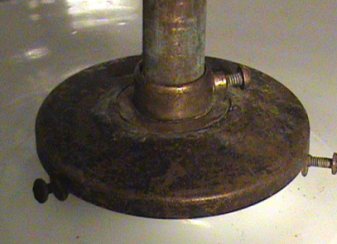
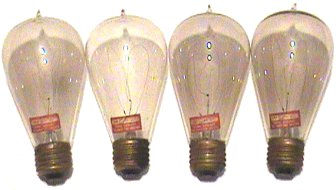
This fixture is for sale at 3850.00 and comes with a matching set
of 4 antique looped filament bulbs with labels marked Boston Inc.
Lamp Co. Danvers Mass. 16 C.P., The 18 3/4 (19 inch) opal reflector
shown, the cluster with four sockets marked "The Hubbell-Grier
Electric Company", five old Hubbell 1901-1902 acorns and antique
Hubbell style canopy.
Note that the cluster shown above does not match the advertised
Hubbell-Grier clusters in that the bottom wiring plate threads/screws
into place. The pictures in catalogs of this time showed the cluster
cap snapping on.
HARVEY HUBBELL COMPANY TIME FRAME (1902-1906)
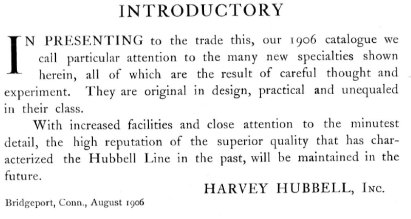
The first catalog to the trade that I am aware of was Catalog
No. 9 published in August, 1906. If there was a catalog each
year, it could be the the first catalog to the trade would had
been 1905 the date that Hubbell incorporated and also officially
documented their first Hubbell Globe trademark with the patent
office.
Known Hubbell Catalog History
Catalog No. 1 - Electrical Specialties Manufactured by The Hubbell
Grier Electric Co. December 1, 1901
Catalog No. 9 - Electrical Specialties Manufactured by Harvey
Hubbell, Incorporated. August, 1906
Catalog No. 11 Hubbell Electrical Specialties Manufactured by
Harvey Hubbell, Inc. August, 1911
Catalog No. 15 Hubbell Electrical Specialties Manufactured by
Harvey Hubbell, Inc. January, 1914
Catalog No. 16 Electrical Specialties Manufactured by Harvey
Hubbell, Inc. March, 1917
Catalog No. 17 Electrical Specialties Manufactured by Harvey
Hubbell, Inc. 1921
Catalog No. 18 Hubbell Electrical Wiring Devices Manufactured
by Harvey Hubbell, Inc. 1925 & Copyright 1925
Catalog No. 21 Hubbell Electrical Specialties 1933-34
Catalog No. 23 Hubbell Electrical Wiring Devices Manufactured
by Harvey Hubbell, Inc. Copyright 1937
Catalog No. 24 Hubbell Rugged Wiring Devices Harvey Hubbell,
Inc. Copyright 1939
Catalog No. 25 Hubbell Rugged Wiring Devices Harvey Hubbell,
Inc. Copyright 1941
Catalog No. 28 Hubbell Rugged Wiring Devices Harvey Hubbell,
Inc. Copyright 1947
List Prices and Index Applying to Catalog No. 28 - Effective
January 25th, 1954
(new pages were issued after 1954 to add to the catalog)
Catalog No. 29 Hubbell Rugged Wiring Devices Harvey Hubbell,
Inc. Copyright 1963
Catalog No. 30 Hubbell Wiring Devices. Undated, but on introductory
page: "New Underwriters' Laboratories, Inc. Requirements
Effective January 1, 1965 Have Changed Ratings And/Or Terminal
Identification Markings on Some Of The Wiring Devices in This
Catalog."
Catalog No. 32 Hubbell Wiring Devices Harvey Hubbell, Incorporated
- (no date)
(Please let me know if you have anything to add to the list
above)
|
 |
 |
A complete list of cluster and cluster switch patents that can be
found on clusters are: 701269,
734875,
734876,
817642
and 872065.
While clusters and the fixture parts shown above and more shown
below) were no longer sold by Hubbell after the 1914 Hubbell catalog,
Hubbell continued to have a large effect on our lighting time table
with other inventions. The pull socket alone was enough to add to
any fixture, but during Harvey Hubbell's life time he never stopped
surprising the industry with new inventions.
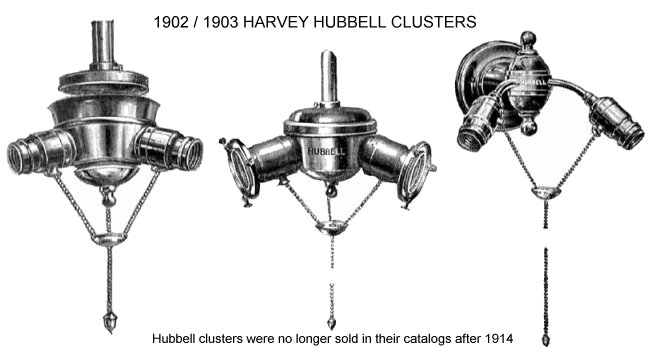
The clusters above were sold starting in 1902 and the first two
are still shown in the Hubbell 1914 catalog. It is unknown when
the third cluster was no longer offered. After the 1914 catalog
Hubbell no longer sold clusters or finishing parts such as canopies
or the type of shade holders for clusters shown here.
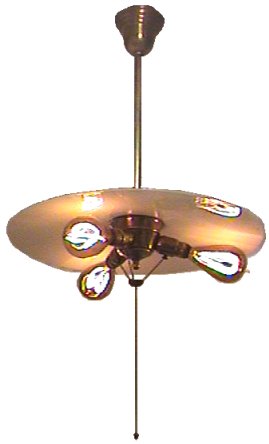
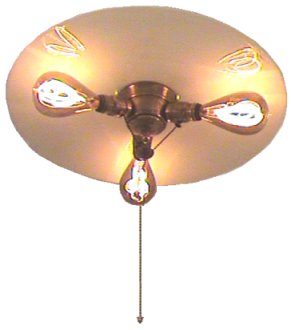
The reflector shown above and on your right is an example of the
first cluster shown in the catalog pictures above. This example
is shown using a 20 inch flat opal reflector and over sized antique
light bulbs.
(For a good idea of the bulb size, compare the bulbs against the
sockets)
Some of the more early clusters are marked and dated while other
later clusters can be found with no marks or signatures at all (only
signed Hubbell sockets). Shown below is an example of a cluster
marked "Hubbell Standard Pull Cluster" PATD. May 27 1902"
It is also marked "Patents Pending". This May 27th patent
was for the Cluster Rosette, not the cluster. Dating this cluster
is easy as the patent for this cluster was approved on July 28,
1903. So this cluster would had been made between these dates.
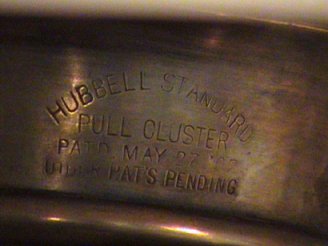
When you have a cluster that is UN marked, the best way to date
it would be to use the normal methods of dating found on this page
and by comparing changes made to the switches during different time
periods.
Early Hubbell clusters can be found in different configurations
as applied together with different styles of lighting at the time.
While most clusters were used together with large white opal reflectors,
you can also find some examples of these clusters being used inside
of different lamp manufacturers chandeliers.
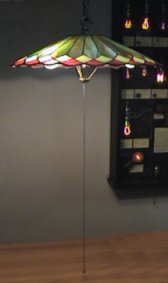 You
can also find clusters in use with different style shades such as
the Handel flat sloped shade pictured on your right which I hung
over this cluster as an example. You
can also find clusters in use with different style shades such as
the Handel flat sloped shade pictured on your right which I hung
over this cluster as an example.
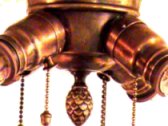 The
cluster shown on your left, has an ornate finial and does not use
a chain rosette. The
cluster shown on your left, has an ornate finial and does not use
a chain rosette.
This cluster was purchased as parts from an old broken chandelier
made by Handel.
It is unknown if the Handel lamp company added the finial after
market, or if Hubbell sold it to them this way.
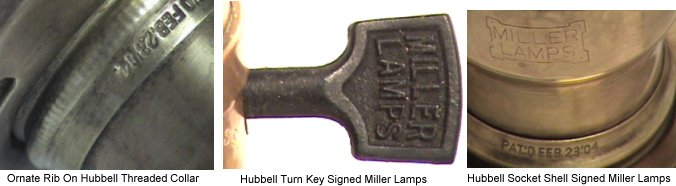
Though it is not yet found in any Hubbell catalogs, Hubbell had
made special parts for lamp makers in the past. An example of this
would be signed socket shells and turn keys for the Miller lamp
company.
Hubbell also made an un cataloged ornate threaded holder ring that
has been found on shade holders attached to Hubbell sockets marked
"Miller Lamps" as shown below.
OTHER HUBBELL ITEMS - ORIGINATING TIME FRAME (1902-1906)
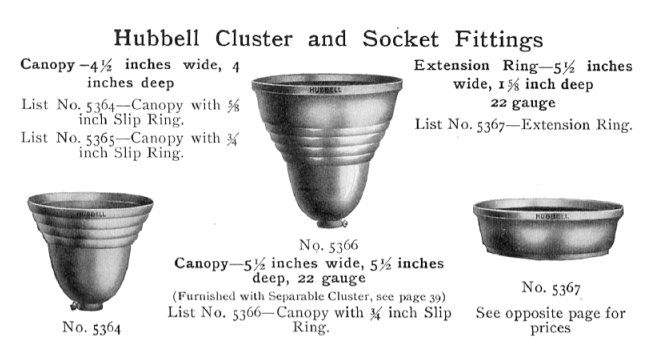
Original Hubbell canopies is a touchy subject. Do you have an original
Hubbell canopy or not? It is hard to tell because this style canopy
was made by other manufacturers through to the late 1920's. There
are however some points of interest that I can point out for you.
Notice that Hubbell sold a unique Extension Ring (shown above).
Notice that the extension ring also has a flat lip at the top. Most
all other canopies made by other manufacturers had this flat top
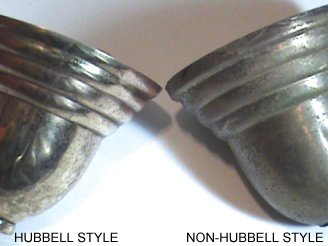
lip on their regular shade holders. Now, notice Hubbell's regular
holder - It does not have the flat lip, it has a curved or rolled
lip. This rolled lip is what I look for to be more politically correct
when matching a canopy to an early Hubbell fixture, but I should
also tell you that these are hard to come by and are quite rare.
By 1914 (which is the last Hubbell catalog selling canopies) it
looks like Hubbell may have changed the design to a flat lip. While
it is hard to tell from the catalog pictures, it is a remote possibility.
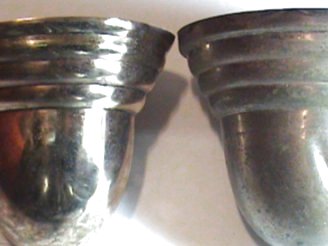
Notice on the Hubbell style that there are four RIBS and the fourth
rib becomes the lip.
On other manufacturers canopies of this style the fourth rib is
the flat lip which means that there are really only three ribs on
non Hubbell canopies (three ribs and a lip). I should also note
that there are other manufacturer canopies with less or more ribs
along with a flat lip, but that is another topic only dealing with
Hubbell canopies right now.
 |
 |
| |
|
The next point to consider when looking to identify an original
Hubbell canopy would be how the extension would have needed
to be attached. In all of my time looking for and collecting
these styles of canopies, I have (to this date) only found ONE
that would qualify as a Hubbell canopy (using the guide lines
below) and it was purchased from me by Hubbell Lighting when
they were putting together a museum and training center in South
Carolina last year. I am looking for others like this, so if
you come across anything please let me know.
|
 |
 |
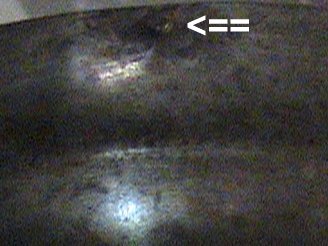
The unique
Hubbell extension ring part No. 5367 shown in the catalog picture
above, could have surely used these three indents around the inner
diameter (and protruding out of the outer diameter) of the canopy
to snap into place.
It could be that Hubbell sold all of their early canopies with the
indents that would be needed to clip on the extension ring, but
I have found rounded lips without them. OR it could be that Hubbell
sold canopies before the invention of the extension ring (we will
know more as we fill in our older Hubbell catalog collection). So
at this point in my research I can not say that all rounded lips
are Hubbell, but what I am almost 100 percent sure of is that rounded
or flat lip canopies with these small indents are original Hubbell
canopies. There is no other practical reason (that I am aware of)
for the three small indents around the rim of the canopy with any
other manufacturer but Hubbell (used for the extension).
It is in my opinion that there are possibly three (maybe four) types
of Hubbell canopies to watch out for.
Canopies with the rounded top lip (post 1901 and pre 1914)
Canopies with the rounded top lip with indents (post 1901 and pre
1914)
Flat lip canopies with the INDENTS to fit the extension ring (post
1914 only)
Also note that it is not known at this time if part number 5366
(extended canopy) shown in the catalog picture above, is all one
piece, or if it is canopy part number 5364 with the extension (part
number 5367) added to it. While it is likely two pieces, it could
be that there is another canopy to search for as well (if it was
all one piece or welded together because the catalog does not tell
us).
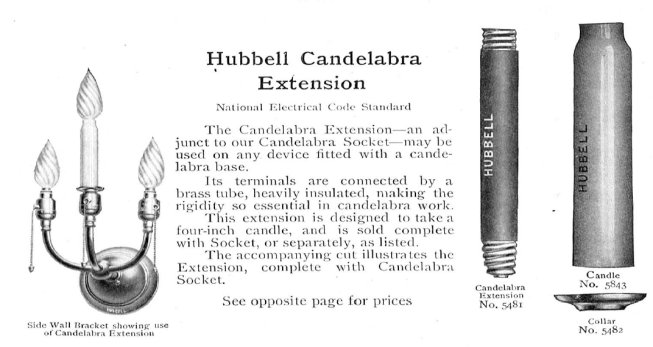
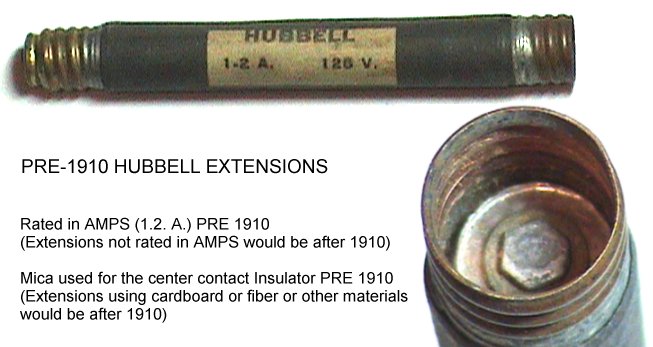
These extensions for miniature sockets are rare though they were
sold in all of the catalogs up to 1921.
They started out black in color with a mica insulator under the
center contact. They changed color to white in 1917.
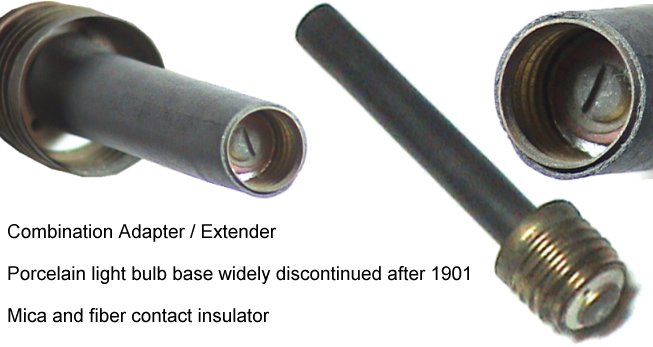
There was also a possible 1902 - 1905 only item that uses a 1901
porcelain Edison base that was widely discontinued and no longer
used for light bulbs after 1901. It looks like Hubbell found a use
for these bases as a combination extender / adapter. This item shown
in the picture below used a regular (discontinued) light bulb base
to adapt a regular base socket to a candle socket. (An extremely
rare item).
A side note that needs to be addressed is that there are some porcelain
base bulbs in use both pre 1900 and some post 1900. It was in the
year 1900 that many bulb manufacturers started using porcelain in
the place of plaster for bulb bases. In 1901 black glass started
being used and later blue glass, but glass for the common bulb base
insulation after 1900. It stands to reason because we do not find
this item in the 1901 Hubbell-Grier catalog, or the 1906 Hubbell
catalog; or post 1906 catalogs; and the historical facts about the
bulb bases, that this was an item offered some time between 1902
and 1905.
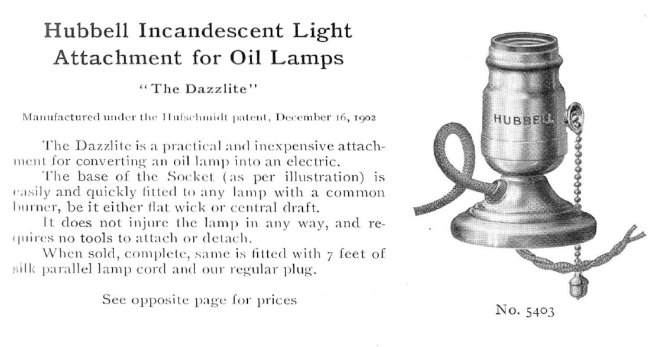
This was no longer called the "Dazzlite" in post Hubbell
1906 Hubbell catalogs. Also no more mention of being manufactured
under the Hufschmidt
patent.
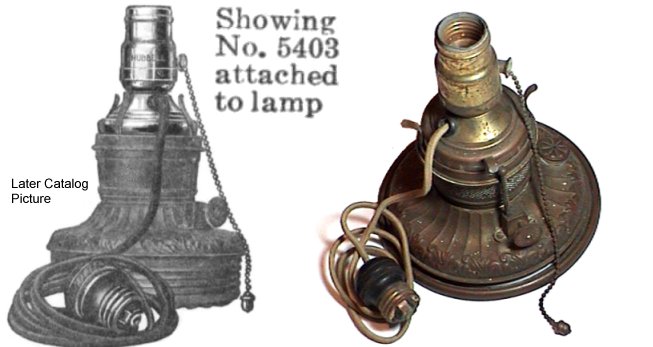
This new invention was offered in Hubbell catalogs as late as 1925,
so when dating be sure to use standard Hubbell socket dating methods
and date the socket attached to the attachment. Though this item
was sold for over 20 years, they do not come up that often. For
example, in a two years of paying attention and watching for these
on ebay I have only seen two come up for sale. Hubbell catalogs
started showing this item attached to a oil lamp after their 1914
catalog as shown below. (In each catalog picture it is shown with
Hubbell's current plug for that time period, but they always use
the same ornate style oil lamp picture which makes for a nice display).
HUBBELL SHADE HOLDERS - WHERE
DID THE IDEA OF UNO COME FROM ANYWAY?
 Keeping
in mind that Hubbell was a member of the Manufacturers Association
and some background history of some of his early statements, it
could be said without any doubt that Harvey Hubbell was an early
father of the UNO concept (if not the original sole father of the
idea). Keeping
in mind that Hubbell was a member of the Manufacturers Association
and some background history of some of his early statements, it
could be said without any doubt that Harvey Hubbell was an early
father of the UNO concept (if not the original sole father of the
idea).
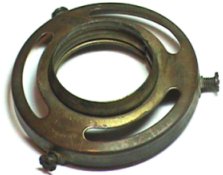
These holders will have two patent dates on them being July 28-03
which was applied for on March 5th 1902 (patent
no. 734874) and Feb.23-04 applied for on June 11th 1903 (patent
no. 753077).
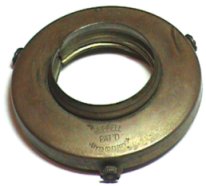 After
1906 Hubbell sold two designs of this holder giving the buyer a
choice of solid or regular. The regular is shown on your right (the
original design) and the solid version on your right (the new design). After
1906 Hubbell sold two designs of this holder giving the buyer a
choice of solid or regular. The regular is shown on your right (the
original design) and the solid version on your right (the new design).
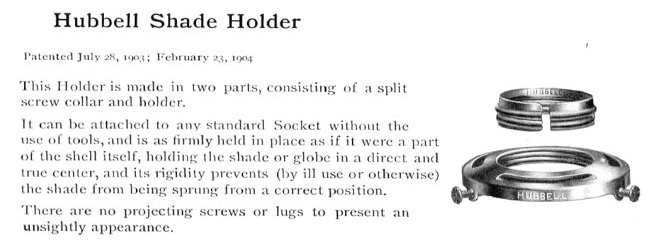
These shade holders were unique in that they used a threaded collar
that would slide on to the provided bead or rib on found on any
manufacturers socket tube.
A picture of this threaded collar is shown below on the Hubbell
1906 catalog page for this holder.
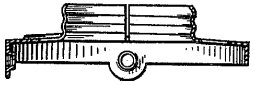
It was the invention of the shade holder above and the threaded
collar that seems to have been brought about by his failed attempts
to persuade manufacturers in general, to thread socket tubes.
 As
early as March 5th, 1902 (which is only a patent applied for date,
which means that likely much earlier), Hubbell had been expressing
the need to do away with shade holders using clamps and clamping
screws to hold it to the socket. His 1902 example (patent
no. 734874) likely met harsh ridicule in that it connects the
Edison threads on the bulb base, to As
early as March 5th, 1902 (which is only a patent applied for date,
which means that likely much earlier), Hubbell had been expressing
the need to do away with shade holders using clamps and clamping
screws to hold it to the socket. His 1902 example (patent
no. 734874) likely met harsh ridicule in that it connects the
Edison threads on the bulb base, to 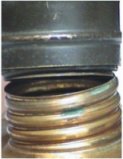 the
shade holder (a conductor) and then screws into the light socket
now making the shade holder part of the circuit. Take note that
in these early days (they did not have black and white wires) it
was a common occurrence to wire a socket with the Edison threads
as the NON-GROUNDED side of the circuit. You could only imagine
what would happen if you were barefooted in a damp basement and
the pull chain was resting against the holder when you pulled on
it. It could be from reading the patent text on the new holders
that this design may had been fixed by threading the center of the
holder ring and then threading socket tubes as special order. But
in any case, this was all solved with this new holder and invention
of the threaded collar (patent
no. 753077). The patent text also shows us a bit more interesting
history and Harvey Hubbell's real ideas and concepts on this issue. the
shade holder (a conductor) and then screws into the light socket
now making the shade holder part of the circuit. Take note that
in these early days (they did not have black and white wires) it
was a common occurrence to wire a socket with the Edison threads
as the NON-GROUNDED side of the circuit. You could only imagine
what would happen if you were barefooted in a damp basement and
the pull chain was resting against the holder when you pulled on
it. It could be from reading the patent text on the new holders
that this design may had been fixed by threading the center of the
holder ring and then threading socket tubes as special order. But
in any case, this was all solved with this new holder and invention
of the threaded collar (patent
no. 753077). The patent text also shows us a bit more interesting
history and Harvey Hubbell's real ideas and concepts on this issue.
| "It
has been a serious objection to this class of shade-holders
as heretofore constructed that it was impossible to attach them
to the shells of standard lamp sockets except by means of ears
and clamping-screws" Harvey Hubbell
1903 |
This shows some obvious contention and Hubbell's
argument towards moving forward and leaving old methods behind,
as well as his global desires. The reply he received was that "it
was impossible". Who was telling Hubbell that this was impossible?
I can only imagine a group of older men hard to change and stuck
with the old ways in their minds sitting on the board of the manufacturers
association. I believe this to be the time frame of Hubbell's early
patent which was border line if not breaking the electrical code
standards of 1901. While there were codes to deal with sockets and
fixtures, this shade holder was not a 'socket' and I can not find
any place where shade holders are covered as becoming part of the
circuit. While there was a mention of bulb bases being exposed,
this was also a null point in that this was a holder not a bulb
base. Stretching the point, it was even loosely termed for bulb
bases as it was written "must not be sufficiently exposed"
in the 1901 rules. The
American Electrician in October of 1904 (broken link) wrote an article entitled
"An Inconsistency In The National Electrical Code" which
makes for some good reading on this topic - BUT we are talking right
now about Hubbell's shade holder. It is clear to me, that Hubbell
was able to get by with this bad design, but that it also ended
in opposition or was modified soon after the patent was applied
for.
Hubbell knew that he was right; and that nothing was "impossible";
so without giving up the fight he pressed forward and on to his
next solution to this issue.
| "The
Preferable means of attaching shade holders to socket-shells
is by means of a rolled screw thread. "Standard socket-shells,",
so called, are not, however, provided with threads". It
has therefore been necessary heretofore either to have specially
made socket-shells provided with screw threads or else to attach
the shade holders to the shells by the objectionable ears and
clamping screws" Harvey
Hubbell 1903 |
Who
here is objecting to ears and clamping screws?
It is the same person Harvey Hubbell that is being told that it
is impossible.
Who is teaching that the PREFERABLE method of attaching
shade holders, is by means of a threaded socket tube? You
are right again, the same person that is saying (in my opinion)
that because manufacturers as a whole refuse to make "standard
shells" with threads, you are forced to have them custom made
or use what they offer you.
| The
result has been that shade-holders having a rolled-thread attachment
have not gone into general use, although that means of attachment
is far preferable, for the reason that the standard-sockets
which are generally in use are not provided with threads"
Harvey
Hubbell 1903
|
It could be
here that Hubbell is talking about his own threaded 1902 holder
since these new holders included both patent dates on them. (Pat
no's 734874 & 753077) It could also be that Hubbell threaded
the center of the early patent holder soon after the invention,
or maybe he is just bringing up the fact that holders are not made
of this type or in general use because there are not standard sockets
from each manufacturer with a threaded tube. In either case, what
Hubbell goes on to say, is that the problem is now solved with this
new threaded collar which will work on the sockets of any manufacturer
threaded or not.
 The
most important thing to be gleaned from all of this though, is the
fact that it was Hubbell giving the directions of how to solve this
general issue by adding threads to the socket tubes. The
most important thing to be gleaned from all of this though, is the
fact that it was Hubbell giving the directions of how to solve this
general issue by adding threads to the socket tubes.
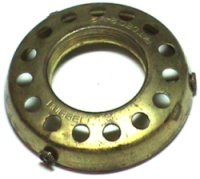
It was Hubbell explaining how to make what was later called the
UNO shade holder (shown on the right) that would work on "standard
threaded socket tubes".
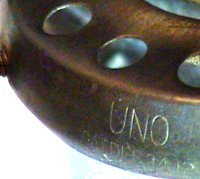 Almost
a decade later we find his type of shade holder in use by virtually
EVERY manufacturer by the year 1917. This all started with the Bryant
patent no.
1048377 issued December 24th 1912, but had already been invented
in the mind of Harvey Hubbell in 1903. Almost
a decade later we find his type of shade holder in use by virtually
EVERY manufacturer by the year 1917. This all started with the Bryant
patent no.
1048377 issued December 24th 1912, but had already been invented
in the mind of Harvey Hubbell in 1903.
You will find these early UNO holders marked by different manufacturers
names such as Bryant, Hubbell, Arrow, etc. You will also find later
holders simply marked UNO with and without the patent date.
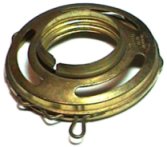 In
1905 Hubbell patented a spring lock version of his holder which
was applied for patent on September 7th 1904 and approved on June
27th 1905 patent
no. 793196 In
1905 Hubbell patented a spring lock version of his holder which
was applied for patent on September 7th 1904 and approved on June
27th 1905 patent
no. 793196
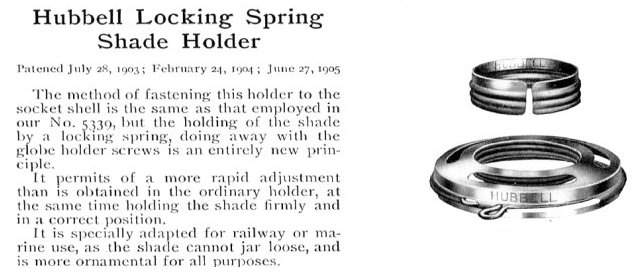
The new spring lock holder will be found with all three patent dates
on it of: July.23-03, Feb.23-04 and Jun.27-05
This new spring lock holder did away with thumb screws and was offered
in the 1906 Hubbell catalog as shown below.
By 1906 Hubbell used his threaded collar on many of his items such
as his wire guards and shades made out of tin, aluminum and steel
as shown below. Since the catalog shows these items with the patent
date of July 28 1903 (the patent of the first Hubbell holder), it
is assumed that these shades used the older shade collar for a short
time and before the new holder and collars were invented. He applied
for patent on the new holder and ring on June 11,1903.
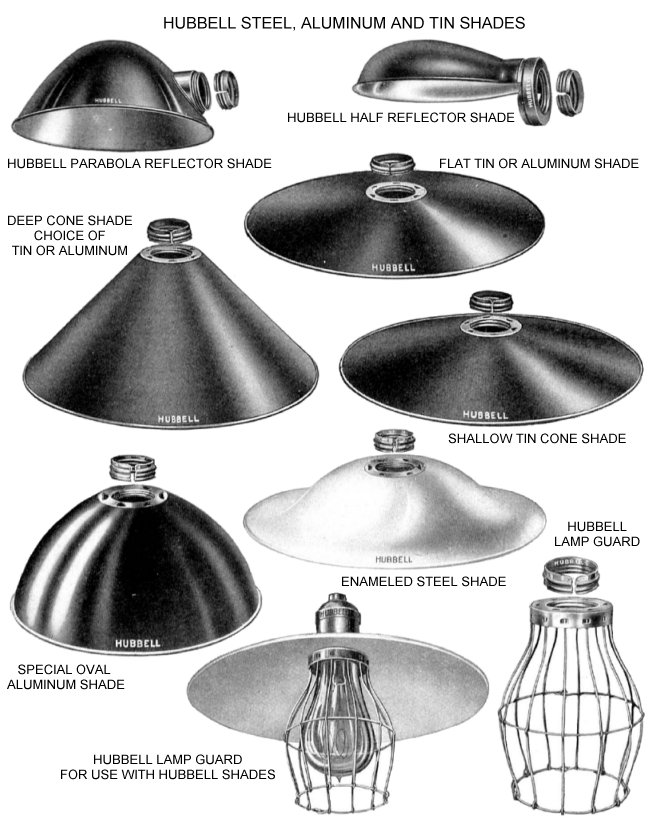
An interesting note is on the parabola shade shown above is that
most early non-UNO versions of this shade were painted and enameled
over brass. Later UNO versions were finished over tin and steel
though there were still brass options in the catalogs.
Starting in the 1914 Hubbell catalog many more styles were offered
(including new long neck options for the new tungsten bulbs) with
a variety of different finish options for the outside of the shades
including polished brass, what they called 'old brass', painted
green and oxidized copper. The insides, frosted with aluminum, polished
aluminum, or white painted or enameled on the inside for most shades.
New size options were also offered having options of 8, 10 and 12
inches
HUBBELL SHADE HOLDER CONTINUED HISTORY
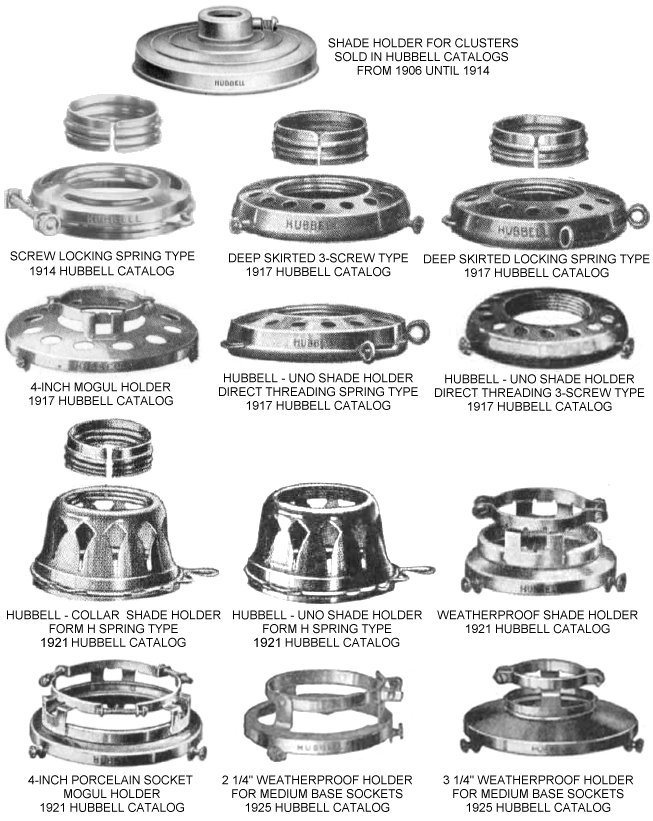
All of the shade holder styles covered above and in the 1906 Hubbell
catalog, are found in Hubbell catalogs for this lighting table time
frame and in catalogs as late as 1925. Below is a short history
of Hubbell shade holders. Each holder shown below is dated with
the first catalog that it was found in. All of the holders shown
below (not the cluster holder) continue through to the 1925 Hubbell
catalog. In 1917 there were too many different styles of steel shades
which was the boom for this type of outdoor lighting (gas stations,
etc.). Because of this there were also examples of which holder
goes with each shade. To view this part of the catalog you
can click here to view the PDF (broken link).
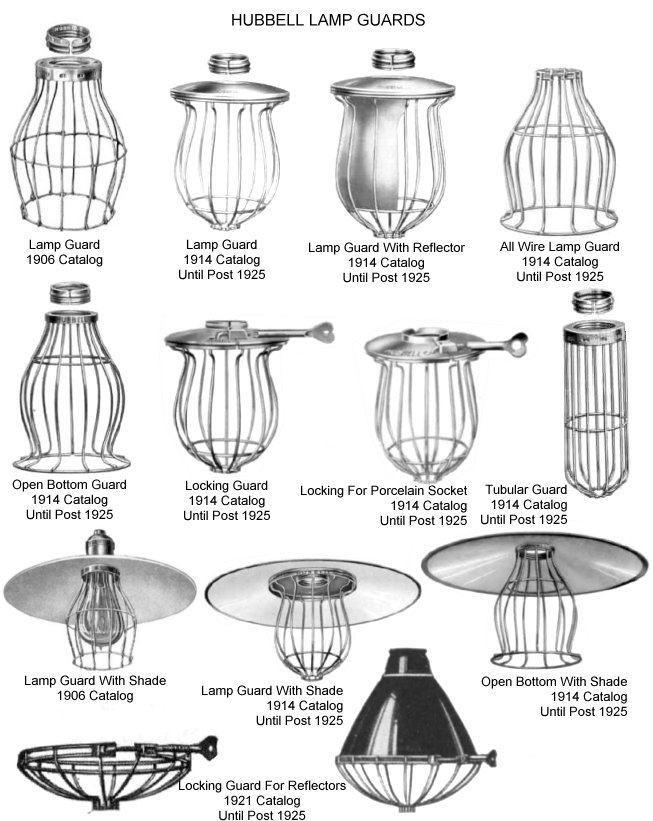
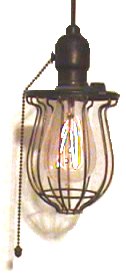 The
wire guards (and locking guards) as shown on your right also started
using the new stackable style (called the nesting guard style) that
was invented in 1911. The old styles of guards took up too much
room on large orders, so this new style was invented that allowed
them to be slipped inside of each other for space saving on shipping
and storage. The
wire guards (and locking guards) as shown on your right also started
using the new stackable style (called the nesting guard style) that
was invented in 1911. The old styles of guards took up too much
room on large orders, so this new style was invented that allowed
them to be slipped inside of each other for space saving on shipping
and storage.
The lamp guards shown above came in different sizes and types from
what is shown above, but the images above show the basic shapes
and styles to look for.
Examples would be that most each guard has long neck options so
that the holder will fit on the shade fitter hole. In other words,
the normal guard would not work on a Hubbell shade, you needed to
purchase the guard that was made for shades. Some were made for
only flat shades while others would work with other style shades.
Also different sizes were made for different size bulb options.
The standard sizes would fit the common 15-25-40-60 watt bulbs and
then another size wire cage for 75 watt and yet another size basket
for long base tungsten bulbs (150-250 watts).
The next most important Hubbell invention that had an effect on
lighting styles was the pull chain extender.
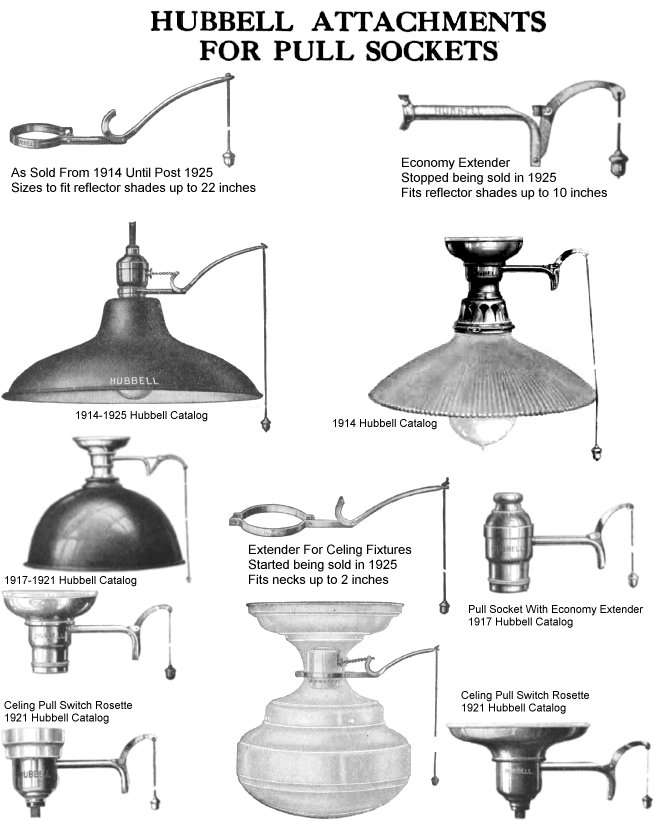
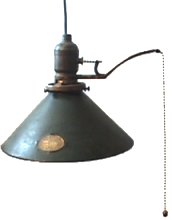 The
concept of an extender goes back pre-1900 where extenders were made
for gas fixtures and their new electric starters. Later for turn
key sockets. While these early inventions were more designed to
extend down for reach, Hubbell had a different thought in mind which
was to extend the pull away from the shade (as well as for reach). The
concept of an extender goes back pre-1900 where extenders were made
for gas fixtures and their new electric starters. Later for turn
key sockets. While these early inventions were more designed to
extend down for reach, Hubbell had a different thought in mind which
was to extend the pull away from the shade (as well as for reach).
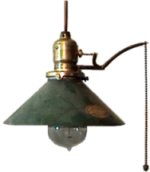 While
there are different styles of these Hubbell extenders, some were
even made to extend the pull chain on reflector shades up to 20
inches in 1914 and up to 22 inches by 1917. While
there are different styles of these Hubbell extenders, some were
even made to extend the pull chain on reflector shades up to 20
inches in 1914 and up to 22 inches by 1917.
These extenders played a part in this lighting timetable and can
be found being used with most any manufacturers fixtures, shades,
sockets and lamps. They simply add an awesome look to a period Frink
or Wheeler reflector as shown on your left and above on your right.
I have even seen these extenders used on bridge floor lamps. I also
found some from an old Hotel that was renovating where they were
used to help control some old short style pendants that were placed
on high ceiling hallways.
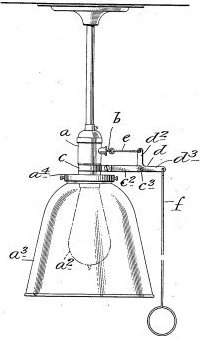 One
of the oldest and more rare extender to come by would be the Klein-Hubbell
patent which was filled November 6th 1909, renewed and assigned
to Hubbell on September 29th 1911 and approved and assigned patent
number 1015897
on January 30th 1912. One
of the oldest and more rare extender to come by would be the Klein-Hubbell
patent which was filled November 6th 1909, renewed and assigned
to Hubbell on September 29th 1911 and approved and assigned patent
number 1015897
on January 30th 1912.
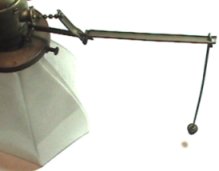
There may had been an early design of this extender as the patent
picture shows to the right, but I has found no examples of it to
this date.
The picture on your left shows what I believe is the result of the
invention after Hubbell took the patent in 1911.
The next most common design was Hubbell called the Economy extender.
The Economy extender was patent applied for patent on April 9th
1910 and was approved on December 27th 1910 and assigned patent
number 979693.
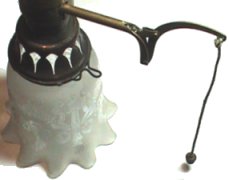 The
Economy extender was invented by Hugh Plunkett and assigned to James
Barry both of of Boston Massachusetts. The
Economy extender was invented by Hugh Plunkett and assigned to James
Barry both of of Boston Massachusetts.
While I can not find any public records that Hubbell took full rights
over the patent, it was redesigned by Hubbell and sold in their
catalogs until the time frame of our lighting table time frame.
It stopped being sold in Hubbell catalogs by 1925.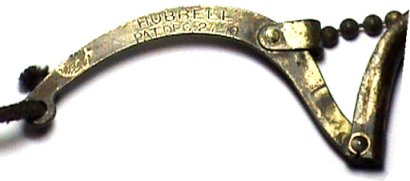
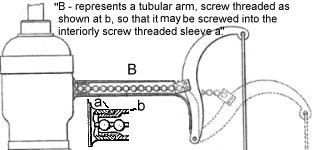 As
shown above on your right, it was marked / signed as a Hubbell item,
which also included the same patent date of December 27th, 1910.
The original patent shows a different attachment method where it
was threaded and screwed on to a socket that provided a removable
chain guide bell (shown on the right in the patent picture. Both
Hubbell and Bryant were selling sockets at this time with removable
bells. As
shown above on your right, it was marked / signed as a Hubbell item,
which also included the same patent date of December 27th, 1910.
The original patent shows a different attachment method where it
was threaded and screwed on to a socket that provided a removable
chain guide bell (shown on the right in the patent picture. Both
Hubbell and Bryant were selling sockets at this time with removable
bells.
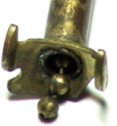 Plunkett
had applied for patent on this invention on April 9th, only three
months later (December 14th) Hubbell applied for his Detachable
Chain Guide patent (943077)
which was Hubbell's new method of attaching the removable chain
guide bell. Bryant and many other manufacturers started using Hubbell's
new chain guide. The new method of attachment was added to this
item as shown Plunkett
had applied for patent on this invention on April 9th, only three
months later (December 14th) Hubbell applied for his Detachable
Chain Guide patent (943077)
which was Hubbell's new method of attaching the removable chain
guide bell. Bryant and many other manufacturers started using Hubbell's
new chain guide. The new method of attachment was added to this
item as shown
It is not known at this time if the original threaded design was
ever sold, but if it was, it would be quite a rare item to own as
I have never seen or heard of one existing to this date.
The next and final Hubbell extender was the style shown below.
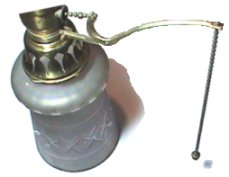
This design was applied for patent on September 21st 1912 and approved
on December 24th 1912. It was assigned patent number 1048169.
This is likely the final result of the Klein-Hubbell patent shown
above.
The 1914 catalog seems to announce it as a new product in that it
states as the opening line in their description for it as "The
next design of the Hubbell Attachment..." when it is the first
in the catalog line up to describe.
These attachments were sold in different sizes for different size
shades. It is easy to spot these sizes if you are viewing them from
pictures.
The first size is like that shown above which was made to extend
the pull for 8", 10" and 12" reflectors.
The next version of the extender was made to extend the pull on
14" reflectors only.
Another extender was sold that extended only 16" reflectors.
In the 1914 Hubbell catalog the final size added another version
of the extender that worked on 18" and 20" reflectors.
In the 1917 Hubbell catalog a new size was added to work on 22"
reflectors.
Note that these
pull chain extenders were all sold with strings and not chains.
All of these extenders shown using ball chain were after market
and added by the consumer.
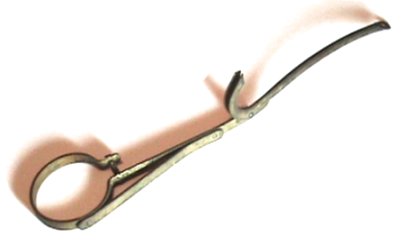 The
most common of these sizes is the one that was made for 8",
10" and 12" reflectors which is the style shown above. The
most common of these sizes is the one that was made for 8",
10" and 12" reflectors which is the style shown above.
The other oversized versions needed a modification to the extender
to give it extra support.
You will notice in the picture on your right that a cross bar was
added, which attaches to the ring and extends the length of the
supporting arm.
If you are viewing an extender from a picture, you can easily spot
the cross bar and identify that is is a more rare extended model.
If it does not have the cross bar, you will know beyond a doubt
that it is the more common version that was made for 8", 10"
and 12" reflectors.
Another note worthy point is that when added to a period fixture,
these extenders can add several hundred dollars to the asking price
and desirability of the item (making it more unique).
For Hubbell Patents: http://antiquesockets.com/hubbellpatents.html
For more Hubbell items and Hubbell history see the link below:
http://antiquesockets.com/hubbell.html
|
ELECTRICAL
SPECIALTY MANUFACTURERS - BENJAMIN
|
TO CONTINUE TO THE NEXT SECTION CLICK BELOW
http://antiquesockets.com/lighting-timetable5.html
|