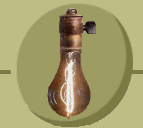
|
BERGMANN
& COMPANY
1881
to 1889
|
|
This Bergmann section is to be the complete socket research
for all early Edison sockets,
as well as the complete lineup of sockets invented or manufactured
by Bergmann & Co..
It also serves as the complete lineup of sockets
manufactured by the Edison General
Electric Company.
Also included is the complete lineup of sockets for the early
part
(1892-1894),
of the
General Electric Co..
Later G.E.Co items (1895 and later) can be found in the geco
section linked below.
More historical
information
about the Bergmann and Edison companies can be found at the
links below:
In the lighting timetable section Overcoming
Obstacles there is a good section on Edison &
Bergmann history
In the "others"
patent area covering basic Bergmann history and some patents
In the geco
section a small mention about the starting of the EGE company
and Edison-Bergmann
In the geco
history section there is a good write up on Bergmann/EGE
history and the Thomson-Houston merger
|
|
How
Edison Fits Into This "Bergmann" Section
|
I
am not as well versed on the early "Edison" sockets
(or history) at this time, but it is pointless starting this
Bergmann section without a semi-detailed history of their origin.
Without the research and historical history below, their would
undoubtedly be a subconscious gap in the readers mind.
This would be because sockets Invented, manufactured by, or
marked with the Bergmann & Co. name, start at such an early
date, that the Edison items shown on this page can become more
of a 'missing link' to some of the Bergmann items. Also Edison
was a part owner of Bergmann & Co., which even makes it
harder to make a clear cut decision as to what is actually to
be called "Edison" or "Bergmann".
There are also some other dilemmas to consider, that we simply
do not yet have the answers for. Sometimes we just need to wait
for new historical evidence to surface.
When trying to bridge the gap between 'Edison' sockets and 'Bergmann
& Co.' sockets, there are many things to consider..
|
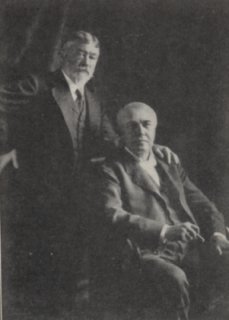 Bergmann Left - Edison Right
 |
Bergmann was a
long time friend of Thomas Edison. He (and E. H. Johnson) had already
been manufacturing other Edison inventions and working for and with
him for well over a decade before Bergmann & Co. was formed. It
was a partnership between three long time friends (T.A. Edison, S.
Bergmann and E.H. Johnson), designed to invent, manufacture and sell
Edison sockets and wiring devices.
|
Bridging
The Gap Between Edison & Bergmann Sockets
|
How
does the reader of this page wish to bridge the between Edison and
Bergmann sockets?
In the end, it all comes down to the personal preference to each
individual as to what they term as a "Bergmann" or an
"Edison" and their reasons why.
Who's invention was it?
Who's name is on the patent?
Was the patent assigned to a company?
Who manufactured it?
Who sold it?
Examples:
If it was invented and patented by Johnson before the partnership,
but then manufactured and sold by Bergmann & Co. after the partnership,
is it to be called a Bergmann, Edison, or a Johnson?
Or, lets say that Edison invents and patents a socket (before the
partnership) which includes a screw shell design; And then Johnson
invents a socket which includes a new part, such as a switch (shows
but does not claim the Edison screw shell in his patent); and then
Bergmann takes out a patent for a new center contact (also before
the partnership or in his own name).
Now later, after the partnership, lets say that we see "Bergmann
& Co." selling a socket with Edison's screw shell, Johnson's
switch and Bergmann's center contact. What do we call this?
|
Reminiscing
& Hearsay Vs. Documented Fact
|
I
am not one to argue over such fine details and leave it up to each
person to come to their own conclusions as to: Which of the sockets
in this research section (that most people strictly call "Edison"
sockets), were actually invented by or manufactured by either Bergmann
or Bergmann & Co.; Or the question of if Bergmann manufactured
all of Edison's sockets from day one; Or where to draw the line
between what we would call an "Edison" socket and a "Bergmann"
socket; Or if we are to draw a line at all.
What it all comes down to are the questions of:
What is actually documented?
What is to be considered hearsay?
Where are we lacking documentation?
For documented evidence we have patents which may include assignees,
dates, illustrations, notes, etc..
Also note that there are some patents from other inventors, authors,
or manufacturers that may provide illustrations which can prove
to us that a particular item existed at the time of filing a patent
or publishing. An example of this would be a patent for a shade
that just happens to picture it on a lamp with a socket. While they
are only claiming the shade in their patent, the socket that they
show must had existed at the time of the patent application, because
the illustration shows it. This also goes for books that may have
been published during certain dates that show pictures or drawings
of electrical items. We also have old catalogs that can provide
some limited information and documentation providing the catalogs
have been updated properly when considering ending dates, but these
are always good for starting dates. Having consecutive catalogs
numbered by years is always a good help to see the entire scope,
as to if they are updating their illustrations in new catalogs.
We also have city directories, and various other documents we can
use when available for dating company addresses in publications.
While
the above is considered good documentation, there are other
resources that can not be as concrete when it comes to direct
evidence. Publications that mix "reminiscencing" with
documentation, cause the reader to try and filter out true facts
from hearsay.
One example of such a work would be a collection of "Reminiscences"
written by Francis Jehl who worked with Edison at the Menlo
Park laboratory in February, 1879 (until 1881 and over 40 years
after running things in Europe). In 1937, he started writing
a three volume book describing his work under Edison and life
in Menlo Park during the Edison years. The book was written
in Edison's restored Menlo Park laboratory, which he claimed
help him bring back many memories. It is important to note though,
that this Jehl book is best for only early memories starting
in 1879 and until 1881 (and even then only limited). |
 |
| |
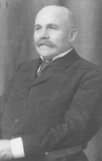
Francis
Jehl
|
Between
these dates the work is simply research that Jehl had done and
called it his "Reminiscences" of which it was not,
seeing he was not working for Edison until 1879 and outside
of the USA after 1881. The book also being an obvious one sided
work, which when controversy arises the other side is not pointed
out. Also in some cases deliberately leaving out entire bits
of history as to make people look good or hide sad facts).
The best example of this would be the Bergmann/Edison falling
out which happened in late 1888. The only point that I make
is that it was never mentioned in the Jehl book that this ever
happened. In Jehl's mind, Edison & Bergmann always remained
close lifetime friends. In one area Jehl quotes:
"Edison once said laughingly: "I got all the glory,
and Bergmann all the money." AND "Years later, when
Bergmann, the millionaire, left America, Edison wrote him a
nice letter which contained the following. "You have nothing
to thank me for, as hundreds of others of my companions and
employees have had the same chance. Your commercial success
was your own doing and I only gave you the opportunity."
While Jehl goes out of his way to make it 'look like' everything
was always fine between them, It is important to note that Edison
in a letter to Bergmann denied all claims to making such a statement
about making him rich. In the Edison letter it states
"I have never yet said anything that I would not say to
your face. 1st, I never said that I had made you rich".
As to Bergmann's 'success' Edison in context also says:"I
have always done everything to help every one of the boys; I
have always been glad they were getting wealthy; the more they
made the better it pleased me; I am glad you are well fixed;
would not do a thing to prevent you making money; all of the
money you have you made yourself by your own ability; that you
had a chance to exercise that ability was due to me; you have
been worked up to a state of dam foolishness by your enemies,
of which you have a very choice and extensive collection."
(I have linked the collection of Bergmann and Edison letters
on this topic here).
The book was completed in 1941 and published by the Edison Institute,
Dearborn, Michigan (Copyright 1937-1941). While this is a great
read (I recommend everyone to read it, but be
sure to get the entire three book set), but, as shown above,
we can not take every word as like a divinely inspired gospel.
People make mistakes; Don't always remember things correctly;
Or simply heard it wrong. There are however some good documented
topics and illustrations. There are also many other publications
that are good reading that document their sources in foot notes,
which are also good as long as you can get access to those sources
to be sure that they are quoted in context. |
Now back to what
we are talking about, which is, reminiscing
and hearsay vs. documented fact.
First, I must say that I have no doubt in my mind, that Bergmann or
Johnson were at least involved in the manufacture of most wiring devices
(including the early days). But, it would be impossible to make clear
rules without the proper documentation, or to attempt to make the
cut between 'Bergmann himself', others with Bergmann and then "Bergmann
& Co.".
We have the actual early sockets to go by (which are not marked with
patent dates or company names), then we have the later sockets that
are marked with patents, and then even later sockets that are marked
with both the patents and the Bergmann & Co. name. It would be
easy to say sockets not marked are "Edison" sockets and
those that are marked are "Bergmann" sockets, but this would
be all fantasy to even think that it could be this easy.
| Jehl says
"At the onset the sockets and other parts were manufactured
by Bergmann & Co., of which the three partners were Bergmann,
Edison and Johnson". (Menlo
Park Reminiscences vol. 2 page 743) |
The "onset"
would imply the Edison No. 1 as well as the first screw shell (#2
on this page, reminisced by Jehl as the bang-up socket in late 1880,
but patent applied for March 7, 1881 with Edison's name is on the
patent).
But, first, lets deal with hearsay and reminiscing vs. documented
fact.
A good example would be in vol. 2 page 744 where I make two quotes
from that page:
"Then
when Edison commenced introducing his light, heat and power
system the firm of Bergmann & Co. was formed, Edison contributing
ideas help and goodwill."
In speaking about Bergmann:
"I don't recall how Johnson became his partner; I suppose
that under the circumstances it was a case of force major. Concerning
Edison's partnership in the concern let me relate in the words
of Charles L. Clark, veteran pioneer: How Edison became a partner
in Bergmann & Co. has an amusing side, told me by Bergmann
with some feeling of disappointment and chagrin, for he strongly
had the dollar-in-pocket instinct. One day, after Bergmann &
Co. (Bergmann and E.H. Johnson, partners) were making the Edison
light fixtures, sockets, switches, etc., Johnson, with his bold
promoter assurance (Bergmann was there), asked Edison how he
would like to become a third equal partner with them. Of course,
Edison jumped at the chance and inquired "For how much?"
At which Johnson (wise man) said: "For nothing but goodwill."
There was a warm handshake to close the bargain, although it
must have given Bergmann chills, for he said to me in telling
the story, "Edison would have been glad to pay us fifty
thousand dollars!" Menlo Park Reminiscences
vol. 2 page 744 |
So here we first
have Jehl making a statement that Edison contributed "ideas help
and goodwill" into the partnership.
This statement and 'belief' of Jehl's is clearly from the third party
communication from Charles L. Clark who says he heard it from Bergmann.
Keep in mind that this was a story being told and then passed down
from person to person. Also all of the details were likely not disclosed.
Who really knows the circumstances that it was being told under, or
to how many people were listening, etc. Also, obvious private parts
being left out of the story. Jehl making the statement "I
don't recall how Johnson became his partner" is simply comical
and had me almost rolling on the floor laughing, since Edison introduced
Johnson to Bergmann in the mid-1870's and Jehl did not start working
for Edison until 1879.
There is no doubt in my mind that this is most all to be considered
hearsay for the following reasons based on documented fact.
Clark quoted:
1. Johnson "asked Edison how he would like to become a third
equal partner with them"
2. Edison asked "For how much?" At which Johnson (wise man)
said: "For nothing but goodwill."
From a draft of the agreement between Edison, Bergmann and Johnson
dated April of 1881:
"Edison
is to receive forty four parts of each dollar of profit earned
in consideration of furnishing the said sum of seven thousand
five hundred dollars, the said Bergmann is to receive forty
four parts of each and every dollar and the said Johnson is
to receive the remaining twelve parts of each and every dollar".
Edison
Bergmann Johnson Agreement dated April 1881 (broken link) |
So here we have
two conflicting statements. Clark says the partnership did not cost
Edison anything, and that it was to be an equal partnership between
the three of them. In contrast, the agreement has Edison paying $7000.00
into the partnership for 44% of the stock. Bergmann also owns 44%
and Johnson 12%, which is not the equal partnership that Clark is
talking about.
On
another note there is first a statement by Jehl "I
don't recall how Johnson became his partner"
which implies that there was a previous partnership between
Johnson and Bergmann. Also in Clarks quote "(Bergmann
and E.H. Johnson, partners) were making the Edison light fixtures,
sockets, switches, etc., Johnson, with his bold promoter assurance
(Bergmann was there), asked Edison how he would like to become a
third equal partner with them." The agreement of
April 1881 surely does not support a concept that a 50/50 partnership
existed between Bergmann and Johnson since in this agreement he
is only now a 12 percent partner.
Johnson worked for the "S. Bergmann" company (since the
1870's) prior to this agreement and was a 12% partner in Bergmann
& Co. after it was formed in April of 1881. About a year and
a half later in September of 1882 he did however become a third
and equal partner with 33% stock (when first agreement was terminated
for unknown reason(s).
The old agreement terminated on September 2nd of 1882, at which
time a
new agreement (broken link) took it's place.
The official 1882 document is linked above and the draft for it
here (broken link).
Noteworthy is the fact that even this later document greatly conflicts
with the statements made by Francis Jehl and Clark, in that it cost
Edison even more money then in the first agreement.
| "The
style of the firm shall be "Bergmann & Co."...
Edison shall contribute to the firm the sum of thirty eight
thousand two hundred and ninety dollars and forty nine cents
in cash, the said contribution to the new firm being the price
which he pays for buying a one third interest in the aforesaid
business...and the receipt of thirty five thousand dollars in
part payment of said sum is hereby acknowledged by said Johnson
and Bergmann." Edison
Bergmann Johnson Agreement dated September 2nd 1882 (broken link) |
There is also documentation in a
signed 18 page letter from Bergmann to Edison dated November 20th
1888, where he is quoted saying to Edison "At that time I asked
you to come in as a partner in Bergmann & Co.which you did and
paid $38,000.00." Notice here that it does not say that "Johnson
asked you to come in" as it was 'reminisced'. Also note that
in this long Bergmann letter that many such statements were made,
in which Edison made a reply and was careful to point out each statement
that Bergmann made that was in error. Edison made no correction as
to who asked him to become a partner.
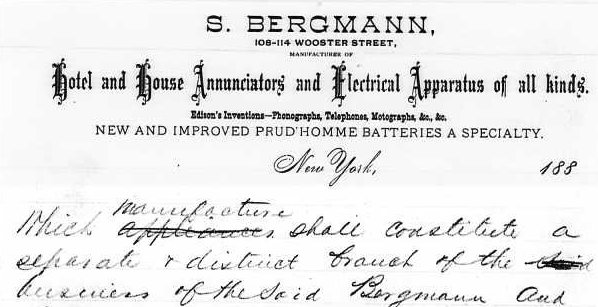
As for the
first agreement, also note that it is solidly documented that the
firm "Bergmann & Co." started it's existence directly
after the first agreement in 1881. This is proven by noticing that
all of the stationary prior to the 1881 agreement (invoices and letters)
used the letterhead of the "S. Bergmann" company; and after
the 1881 agreement used "Bergmann & Co." letterhead
as shown below.
This is
a part of an agreement draft in 1881, that was actually made
on the current stationary about the same time as the first 1881
agreement.
 |
Now
soon after the 1881 agreement, I show (only two out of hundreds
of examples) an example of one Bergmann & Co. letter
and one invoice:
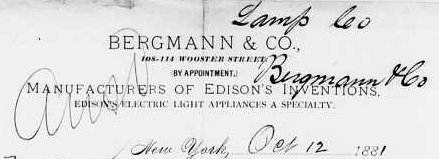
Example of Bergmann & Co. Letterhead Dated Oct. 12 1881
|
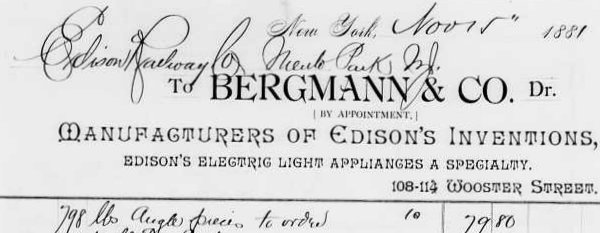
Example of A Bergmann & Co. Invoice Dated Nov.15 1881
|
The point of all
of this being, that you can not trust EVERYTHING you read!
This socket research section will be based on actual fact to the best
of my ability.
If a statement has been reminisced, I will be sure to either say so
or go out of my way to document it as fact before presenting it as
such.
|
The
Key To Understanding The Socket Research Below
|
NUMBERING
OF SOCKETS
In this research in this section, I will refer to "Bergmann
& Co." sockets as those that are without any doubt a total
Bergmann & Co. invention. I will make a clear difference in
naming them and start the BERGMANN NO. 1 SOCKET with the first actual
socket known to be a complete Bergmann & Co. Invention This
is even though there are other sockets named for example "Edison
No. 3" or "Edison No. 4' that were either undoubtedly
manufactured by Bergmann and / or, share partial patent claims.
EDISON VS BERGMANN
When dealing with sockets manufactured after April of 1881 it should
be noted that there is really NO REAL DIFFERENCE between items manufactured
by "Bergmann & Co." and should be considered no different
then EDISON system sockets. This is because Edison was a partner
in the company and did not manufacture sockets for his electrical
systems from any of his other manufacturing companies.
More accurately these should be called EDISON-BERGMANN items
until those manufactured after April 24, 1889.
Edison consolidated his electric companies in 1889 (which included
Bergmann & Co.) into a new company called "Edison General
Electric". After this, Bergmann no longer played a part in
the the new company (as he went on to invest in other new 'NON-Edison'
ventures).
So, now we have "EDISON-ONLY" Items from April
24, 1889 until April 15, 1892.
In 1892 there was another merger with Thomson-Houston in which those
that owned stock in "Edison General Electric" were paid
off (including Edison) and the company was merged. Thomson-Houston
(now owning Edison's name for electrical) created a new company
called "General Electric" and merged all of their electrical
companies into it (also, at which time Edison himself was no longer
part in the company).
So, to be quite clear, we now have NON-EDISON items from
April 15, 1892 until present time.
Items after 1892 would be called or marked General Electric Co.,
G.E. or G.E.Co..
SOCKET LINEUP - Socket numbering and
timelines through company life times
I will also deal with sockets in timelines for particular styles
or designs.
For example, one socket style such as the "Acorn" socket,
started as an 1882 Bergmann design and invention, which was then
slightly changed when it became an "Edison General Electric"
item. Also when "General Electric" came out with their
socket line, they made some slight changes and came out with their
own acorn socket. So, in cases like this, I will deal with the complete
lineup of acorn sockets starting in 1882; And then moving through
each of the three companies until the last documented change. This
will now give us a lineup of Acorn sockets such as No. 1, No. 2,
etc., but some of them being documented as Bergmann, E.G.E. or G.E.
sockets in the line up.
Now with all of this being said, we will get on to
the actual socket research.
To
continue to the socket research part of this page:
Click Here http://www.antiquesockets.com/bergmann2.html
|