|
HOME
|
Back to the main home page and front menu |
|
I have not had much time to get many items in the forsale area below. Please keep checking back as I will start adding more items soon. Items
For Sale |
Switch Material Electrical Code Mica Insulation CP or WATTS Marks Socket Bead/Rib/UNO Catalogs & Ads Patents Pull Chains / Finials Bulb & Socket Bases View images of the most well known bulb and socket bases |
|
Socket
& Electrical Manufacturer's Items And Their History
|
| GECO
Sockets This section will allow you to date and learn how to tell one GECO socket from the other. Hubbell This is where this site started from. Since this page was done, there has been much more Hubbell history and information found which will make for a complete redesign of this page and section in the soon future. Hubbell Patents This section has some early patent research on Hubbell. It is mostly complete with only a few missing patents which will be added in when this section is re done into the new format Wheeler Reflector Co. A history of The Wheeler Reflector Company and tips on how to tell if mirror has been replaced on a shade Other Manufacturers This section is a lot of incomplete work and will be updated shortly. For now it serves to give you some extended information on some companies, but will be a much better tool when it is complete NEC This section is everything you ever wanted to know about the National Electrical Code (NEC) but had no one to ask. Downloads of old NEC's, meetings and much extended information is provided. Cord Balls & Adjusters My cord pendant adjuster project, as well as a good history about them. |
| GECO
Sockets More companies will be added to this list in the near future. We will also be adding a new list of post 1900 sockets and items. Bergmann & Co. Brush Electric Co. Bryant Electric Co. Crown Elect MFG Co. EE&S Holmes & Gale (HG) Perkins Thomson-Houston Westinghouse |
|
Tutorial
And Early Lighting History
|
|
To
read the entire tutorial, you can just click on the first link and
then continue to the next section at the bottom of each page. Or,
you can select links below of interest to you. |
   |
THIS PAGE WAS
CONTINUED FROM HERE
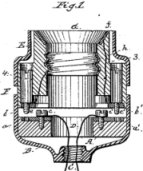 Just
as in the same case with the number 2 socket patent, the no. 3 socket
was complete many months before the patent application was filed.
The patent for the Johnson bevel ring was filed May 27th 1881 and
approved on December 27th 1881. It was assigned patent no. 251,596.
The patent for the bevel ring bulb for this socket (Edison's patent),
was applied for on November 29th 1881 and approved May 12th 1885.
It was assigned patent no. 317,631 Just
as in the same case with the number 2 socket patent, the no. 3 socket
was complete many months before the patent application was filed.
The patent for the Johnson bevel ring was filed May 27th 1881 and
approved on December 27th 1881. It was assigned patent no. 251,596.
The patent for the bevel ring bulb for this socket (Edison's patent),
was applied for on November 29th 1881 and approved May 12th 1885.
It was assigned patent no. 317,631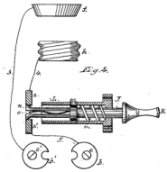 The
work on the bevel ring socket likely began some time between November
12th and December 29th of 1880 and was complete by January 27th 1881
for both the key and keyless versions of the socket. The
work on the bevel ring socket likely began some time between November
12th and December 29th of 1880 and was complete by January 27th 1881
for both the key and keyless versions of the socket.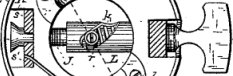 It
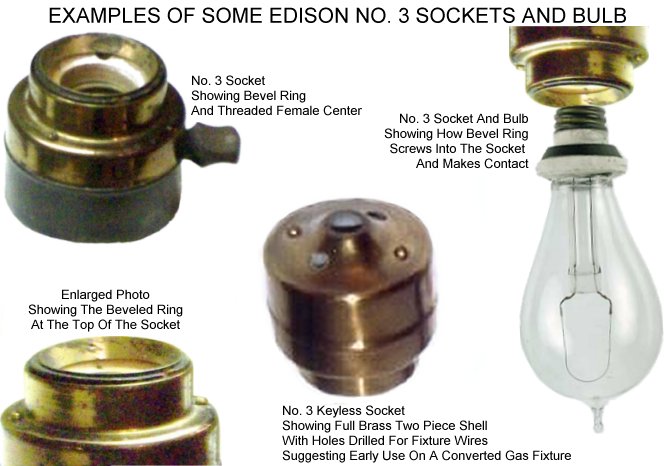
is important to note that the Johnson patent only covered the bevel
ring part (shown left top) of the socket and his new switch design
(shown left bottom). The threaded screw shell was already patented
by Edison in his patent
for the No. 2 socket, which covered many different possibilities
of different screw shells. It is noteworthy that the new Johnson turn
key shaft (shown above to the right) uses the similar grooved screw
design that later Bergmann & Co. sockets will use. The noticeable
difference between this switch and that of Edison's patent, is that
this design only allows the key to turn on one direction. Half turn
in one direction to turn it on; and then a half turn back, to turn
it off. The Edison switch design (seen on the No. 2), was a snap switch
design that you could turn in any direction and around and around
again. It
is important to note that the Johnson patent only covered the bevel
ring part (shown left top) of the socket and his new switch design
(shown left bottom). The threaded screw shell was already patented
by Edison in his patent
for the No. 2 socket, which covered many different possibilities
of different screw shells. It is noteworthy that the new Johnson turn
key shaft (shown above to the right) uses the similar grooved screw
design that later Bergmann & Co. sockets will use. The noticeable
difference between this switch and that of Edison's patent, is that
this design only allows the key to turn on one direction. Half turn
in one direction to turn it on; and then a half turn back, to turn
it off. The Edison switch design (seen on the No. 2), was a snap switch
design that you could turn in any direction and around and around
again.DOCUMENTING THE PROGRESSION OF THE NO. 3 SOCKET It was reminisced by Francis Jehl "Toward December of 1880 Edison remarked casually one day that it would be better if the metal ring at the bottom of the lamp base were given the form of a cap. The change in the form of the socket and lamp base came about in this manner... Johnson took out a patent for a bevel ring instead of the straight one shown in Edison's patent...Sockets that were sold in 1881, in fact the first ones, were fitted out with the Edison screw shell and the Johnson bevel ring" (Menlo Park Reminiscences vol. 2 pages 743-745) 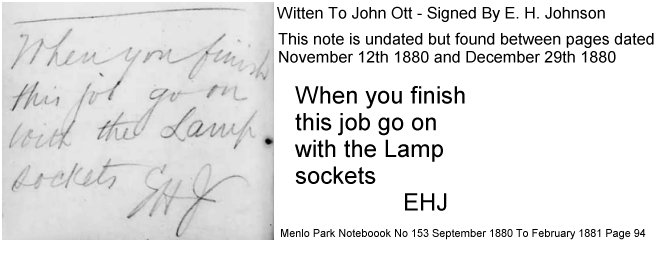 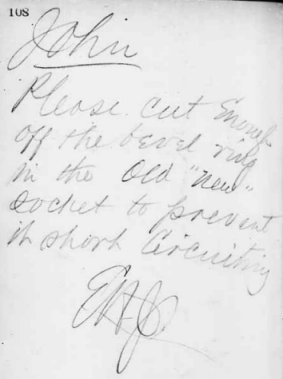 As
seen above the work on the new socket started sometime after Nov.
12th and before December 29th. As
seen above the work on the new socket started sometime after Nov.
12th and before December 29th.This was a work in progress as right after a note dated Jan. 3rd 1881 on page no. 108, we find this note asking to cut off some of the old "new" socket. This note written to John Ott and signed by E.H. Johnson reads: John Please cut enough off the bevel ring In the Old "new" socket to prevent it short circuiting EHJ Good records were kept in this notebook, which were all signed and witnessed for patent records. These records would be needed if there was ever a patent dispute for an invention after the patent was applied for. Many such drawings are in this notebook pertaining to different inventions, of which I document the most important of the Johnson patent below. 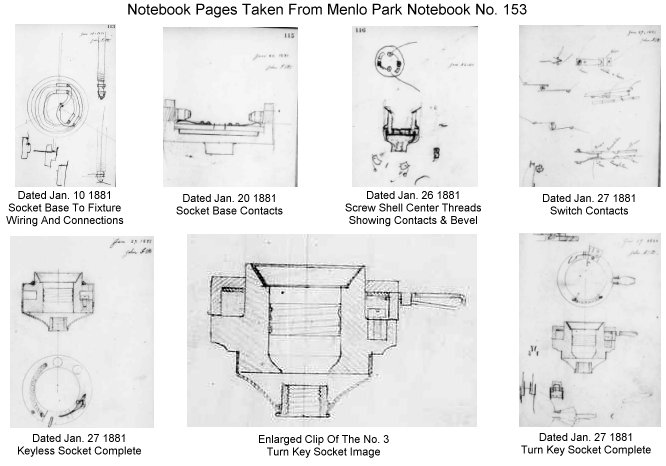
This topic is continued into the next section - The Edison No. 4 Socket. 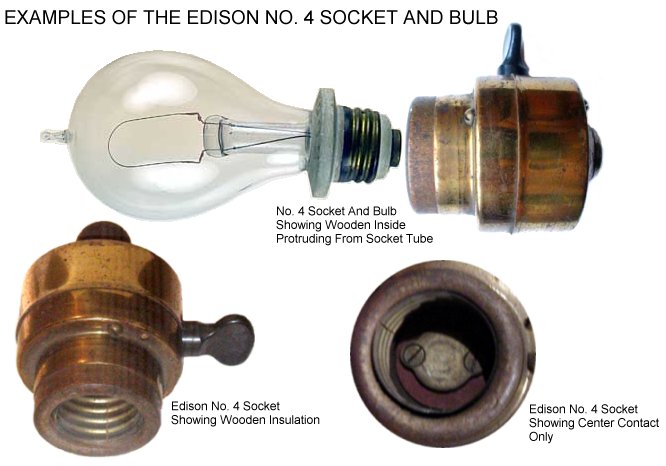
After the problems were found with the bevel ring socket it was not long before the new center contact patent was applied for. While the patent points out that this socket is simply a no. 3 with a new center contact, this was only in the sense that the basic socket design and contacts were the same. It was however different pertaining to the insulation and center contact, which gives a different look and feel to the socket. Jehl reminisced:
The above Jehl statements leed me to think along the lines that he is trying to give as much credit to Edison as he can without providing documentation. This is only my opinion, but I think he is stretching things a bit too far for someone that was not even in the USA at the time this happened (or for almost 30 years after). His statements such as "and no doubt Edison confided that he once had thought of making the straight ring" AND "It seems that Bergmann then got the idea of making a small cup" Where I highlighted bold print above, it is not hard to see that Jehl, was giving only his thoughts or made up fantasies in his mind. He is not quoting sources like so & so said, or I think I remember someone telling me, or I heard it from somewhere; He is summarizing by using the phrase "no doubt" and giving his own undocumented conclusion of "it seems that". There may be some truth to the basic story, as Bergmann starts off his patent talking about the old cracking of the plaster. However, in my mind, this is a total Bergmann original thought and invention, until I see documented evidence showing otherwise. It is also noteworthy that we have seen this at least once already too, when it came to Johnson's bevel ring patent. Jehl also gave the credit to Edison for the original thought of the invention without providing evidence. As Joe Friday would say: "All we want are the facts, ma'am"
The undocumented socket shown below was found in a box of early sockets and electrical items, that was documented as being passed down through relatives of Francis Jehl. Just as the documented No 4, this socket uses the new Bergmann center contact and Johnson switch. But, unlike the documented version, this one is a wood socket with an iron cap. It was likely an early special use socket. This socket is a real treasure having never seen anything like it documented anywhere (so far). 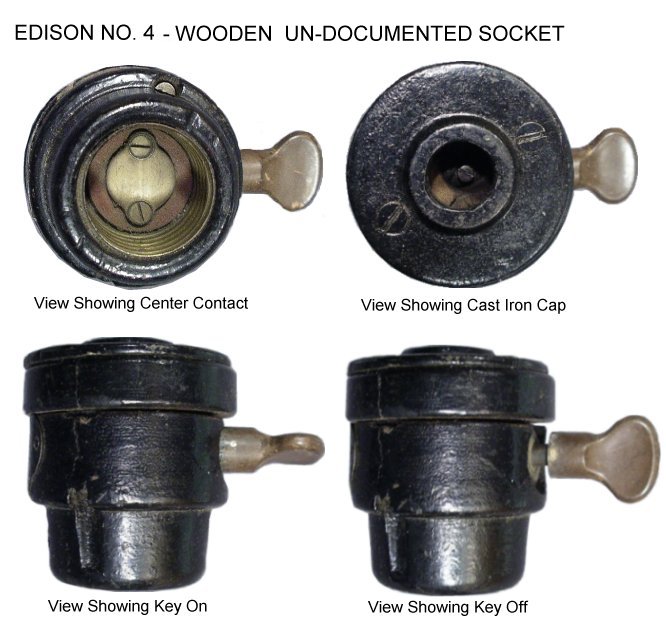 While writing these pages, I have been trying to piece together obvious projects as part of a puzzle. I should mention that I did have a small piece left over that I did not know what to do with. After much thought, this may be where it fits the best. Keeping in mind that what ever special purpose this socket may had been used for, it was possibly also needed months before this patent as well. If true, then there could have also been a bevel ring version (no. 3) of this socket in existence as well (and possibly a no.2). While going through Menlo Park notebook no. 153 (with the making of the fixtures and sockets), I noticed two entries AFTER the no. 3 had already been complete. These references were to the "fixing" of wooden sockets to the new design. "John please fix this one to turn like the others" ... "John Ott, please have the new wooden sockets which will probably come in Monday, all fixed like this one..." I had first thought that this was simply referring to no. 2 sockets being retooled (since the body of them was wood), but after looking closely at the no. 2 (and comparing it to the new no. 3 socket), this would be more unlikely. Since the no. 2 was already a wood socket to start with, the only difference in a special use socket of the type shown above, would have been the heavy iron plate or cap. If Johnson was asking Ott to fit a special use socket (one without the new brass cladding) with the new bevel ring, it would follow that this wooden special use socket would now need the new center contact as the one shown. While this documentation could fit elsewhere, I bring it up as possibly best fitting to this type socket. I mention it so that the reader can build on it (or debunk it), if other future documentation ever surfaces. A special thanks goes to Adam Allerhand for providing the history and the photos of this socket from his collection.
 The
patent for the new center contact was applied for on February 25th
1882 and approved on May 2nd 1882. It was assigned patent no. 257,277.
The next socket in line after this patent, is the Bergmann No. 1 which
was applied for on October 9th 1882. The
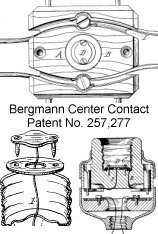
patent for the new center contact was applied for on February 25th
1882 and approved on May 2nd 1882. It was assigned patent no. 257,277.
The next socket in line after this patent, is the Bergmann No. 1 which
was applied for on October 9th 1882.The only early bulb patent that I could find close to the date of the application for the center contact, was applied for on August 7th 1882. There were two patents applied for on the same day which were assigned patent numbers 275613 and 401646. The center contact patent was assigned to S. Bergmann as the Inventor. I should mention that there was an agreement between Edison, Johnson and Bergmann at this time, but as far as I know, it did not cover patents until the next signed agreement which was after the application date of this patent. There is no doubt that this patent is to be considered a Bergmann & Co. patent (even though Edison, Johnson or Bergmann & Co. are not assigned), but for future reference and later patents I quote from the September 2nd of 1882 agreement.
This no. 4 socket is derived from a combination of patents. The screw shell is covered by Edison's patent (no. 251,554), The switch (and every other part) by Johnson's bevel ring patent (no. 251,596) and now the center contact by Bergmann. In this patent Bergmann points out the following on page 2;80: "In Fig. 1 these parts are shown as applied to a lamp-socket in which the connections are exactly the same as described in Patent No. 251,596, granted December 27th, 1881, to E. H. Johnson." DATING FROM EDISON AND BERGMANN CATALOGS Unfortunately, dating sockets from early Bergmann catalogs can be an almost impossible task since for some reason through the years, Bergmann & Co. only made new catalog illustrations for new items. Let me explain: If a socket is shown in the 1883 catalog and improvements (or even drastic changes in it) were made through the years, the new catalogs will only reflect the first design of it (and never update their illustrations). HOWEVER, if a new fixture such as a chandelier or pendant was to come out that has not yet been shown in a catalog, the fixture would be illustrated using the new socket design. These fixture illustrations however, are almost always totally useless, because most times the sockets are partially hidden by a shade holder or too small on the fixture to make a positive identification. I should first inform you that presently when it comes to Edison, or early Bergmann & Co. catalogs we are a bit lacking as they are not easy to come by. Currently we have dated 1882 and 1883 circulars/brochures "The Edison Light" which were published by "The Edison Company For Isolated Lighting" (formed in November of 1881) (broken link), in which the 1883 includes a complete undated Bergmann catalog. While the Edison Light is dated 1883, there is no way to positively confirm what dates the items in the attached Bergmann catalog contain. It could possibly contain 1883 items and updated illustrations, or it could had been added to the 1883 Electric Light at a later date. Also, as we get into the Bergmann socket section, we currently have Bergmann catalog no. 5 and no. 9 to try and help us with other Bergmann sockets. The undated 1883 Bergmann catalog has a mixture of different sockets shown, which includes the no. 3 (Johnson bevel ring) shown in the socket section; And the no. 4 shown on some fixtures. There are also new Bergmann sockets included, which we will cover later. As shown in the illustrations below, the 1882 Edison Light shows the No. 4, and the 1883 Edison Light shows a new Bergmann socket (the Bergmann no.1-A). So, from this we can at least see that in 1882 the no. 4 socket was being sold and by the next year an illustration of a new socket was being shown. By the time the Bergmann no. 5 catalog comes out, this no. 4 socket was no longer shown as for sale and only a small number of fixtures show it on them. By this time most of the fixtures are newer ones (showing new sockets) with only a small number of older fixtures (without updated illustrations). 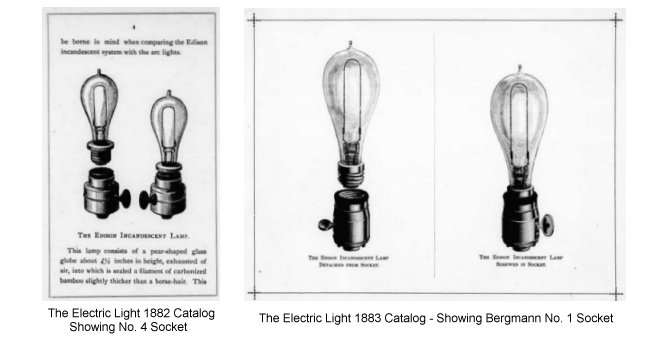 It is also noteworthy, that since the Edison Company For Isolated Lighting was new, 1882 would had been the first "Electric Light" published and likely the no. 4 socket illustrations current. Also note that in the following year, at the publishing of the new illustration they used an earlier version of the Bergmann no. 1 socket then what was shown in the attached Bergmann catalog. This could indicate that the Electric Light predates the Bergmann catalog, or the Electric Light only had access to these newer illustrations at the time of preparing the catalog..
The Bergmann patent for the center contact was used on many other items as well as revolutionizing Edison's industry by use of this improvement to a now successful invention. Page no. 2;15 of the patent quotes "The invention is applicable to sockets of all kinds used in systems of electric lighting, whether for lamps or for simple plugs, for connections or for "safety-catch" plugs, such as are used in the "cut-outs" or blocks for branching circuits." Many new and improved inventions started coming out early 1882 and by 1883 even more new sockets (based on this invention) which were used on an almost never ending creation of lighting fixtures and new wiring device inventions (a few of which is shown below). 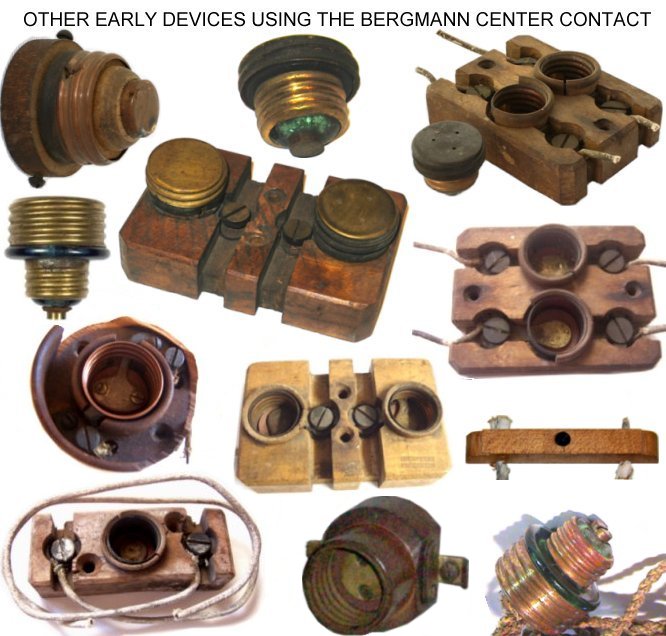 With the Edison part of this Bergmann section completed, we are now ready to now move on to the next socket in line which is the Bergmann No. 1 socket. But, first lets recap the Edison sockets using a comparison to help you identify the differences between them at a glance.
 Even
though we have gone through the different Edison socket versions,
there are some quick pointers to help you ID the different sockets
at a quick glance. Even
though we have gone through the different Edison socket versions,
there are some quick pointers to help you ID the different sockets
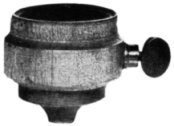
at a quick glance.The Edison No. 1-A, 1-B and 1-C are easy sockets to ID, so I will not cover those. If you don't remember, just go back and look at the pictures. The 1-A has the outside wiring terminals, The 1-B wires down through the cap and the 1-C is of a different shape. The Edison No. 2 socket is also easy to ID simply by the cap and small wooden body shape as seen on your right in the drawing of it. There is no other socket in history that looks like this no. 2 socket. So, if you see this cap shape and body design in a picture, you can rest assured that it is this rare socket no. 2 socket. 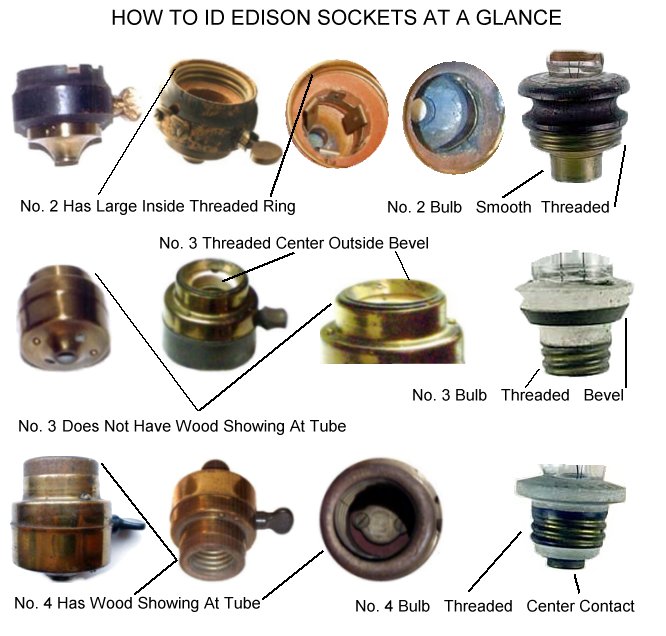 As seen from the illustrations shown above, the number 4 socket (and bulb) is more like those of today which have the outer threads and a center contact. This socket completes the basic 'Edison socket invention', with only minor material and small design changes until present day.
To
continue the socket research to the next part: |
|||||||||||||||||||

 |